No Tarts in Bakewell

DonQui has been travelling around quite a bit this past week. On Saturday he found himself in Bakewell — gateway to the Peak District if you are coming up from the south.
Bakewell-Bridge-Derbyshire.jpg

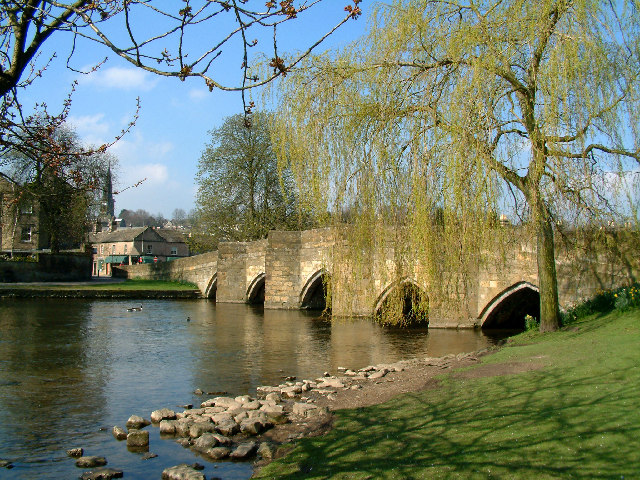
It is a pretty town with an ancient feel to it although DonQui learned that the many grey stone buildings only date back to Georgian times when they replaced the old medieval timber framed houses. The bridge over the River Wye is, however, truly old. It dates back 700 years and is built on Roman foundations.

DonQui had heard that Bakewell was famous for its tarts. This made his ears perk up until he learned that they were of the baked variety and even then they were not properly tarts at all. In Bakewell the almond paste, jam and pastry confection is a pudding. According to the Bakewell Pudding Shop the original recipe was a mistake when a cook, making a strawberry tart, poured the egg mixture over the jam instead of mixing it into the pastry.

3671008228_ef58d7a60a.jpg

To be truthful Bakewell puddings or tarts are not high on DonQui’s list of favourites. He was in need of something a little more refined. Stopping off at The Peacock for an afternoon pint of the local ale he ascertained that he would not be having dinner there. Although the food looked good the prices did not. He thought that £15 for a burger would make even a Panama accountant’s eye’s water.

On his way back from strolling along the river, by happy chance he passes Riley’s Restaurant. Menu looks interesting. He sticks his nose inside the door, Nicely decorated. It is mid afternoon and the lunch crowd has long moved on. A pleasant young man comes over and asks if he can help. DonQui decides to reserve for dinner.

IMG_7128.jpgLater that evening DonQui had one of the best meals he has had in a long time. A bowl of muscles in a delicious coconut lime broth to start, followed by a most exquisite dish of sous-vide lamb rump with a medley of spring vegetables.

DonQui has heard of the sous-vide cooking method before but has never tried it. Basically it seems to involve putting the meat in a vacuum sealed bag and cooking it for many hours by immersing it in moderately hot water. The result is evenly cooked, tender and utterly delicious. The medly of vegetables included asparagus, sprouting broccoli, pea shoots, peas and finely sliced radishes. Together with the juice from the lamb it had a wonderfully fresh, crisp, spring-like taste.

IMG_7131.jpg

Duchess had half a lobster which was also delicious.

DonQui liked the ambiance and he liked the staff, all of whom were friendly, cheerful, helpful, and clearly proud of their establishment.
IMG_7121.jpg

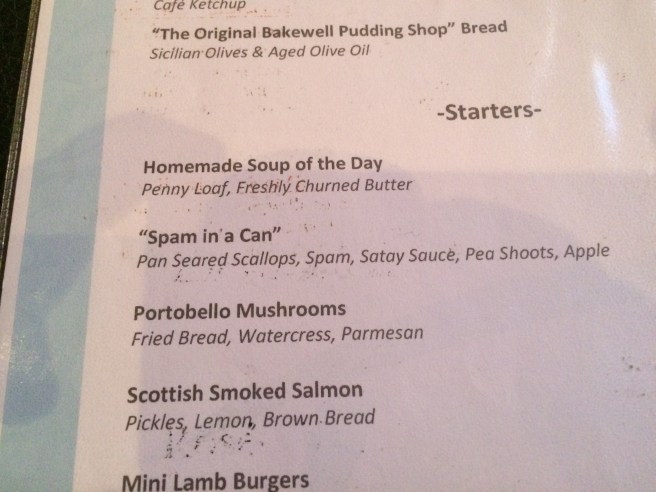
The chef also has a good sense of humour. DonQui considered trying out ‘Spam in a Can’ but didn’t— maybe next time.

Easter Lamb

At Easter DonQui Oaty really likes to cook a leg of fresh spring lamb. He has been doing this for years following a recipe he has adapted from Gourmet Magazine (April 1990). As usual DonQui’s measurements are rather imprecise as he rarely measures anything precisely.

Ingredients
1 whole leg of lamb
2 carrots roughly chopped
2 onions quartered
1 celery stalk roughly chopped
olive oil

For the Marinade:
2 crushed garlic cloves
a good amount of chopped fresh rosemary
a good amount of chopped fresh thyme
1 tablespoon Dijon mustard
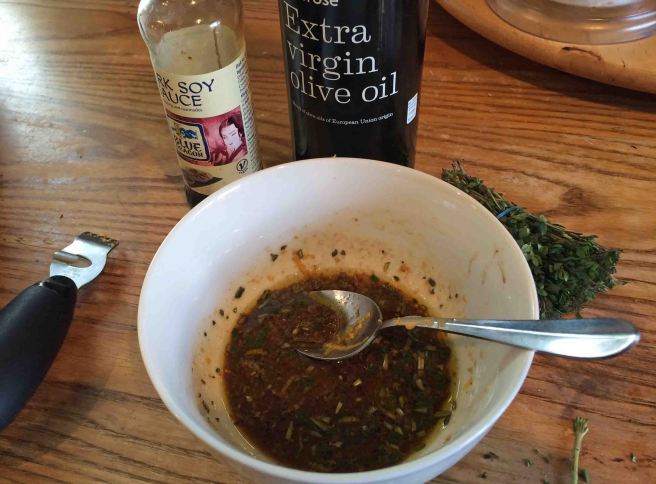
1 tablespoon soy sauce
a good glug of olive oil
a good glug of dry white wine
lemon zest
pepper to taste

marinade.jpg

Whisk together all the ingredients for the marinade in a small bowl. Rub into the lamb all over, reserving a bit for cooking later. Place the lamb in the roasting tray and loosely cover with foil. Leave to marinate in the fridge for at least 4 hours — even better if you can leave it overnight.

lamb start.jpg

On the feast day take the lamb out of the fridge at least an hour before cooking so it comes up to room temperature.

Pre-heat oven to 240ºC

Place the chopped vegetables on the bottom of the roasting pan and drizzle with olive oil. Place the lamb on a rack above them.

Put it in the oven and roast in the middle of the oven fat side up for 10 minutes at the high heat.

Turn down to 180º and roast for another 1 hr 10 mins (1hr 20 mins in total for a full leg)
At about the half-way point brush the lamb with the reserved marinade.

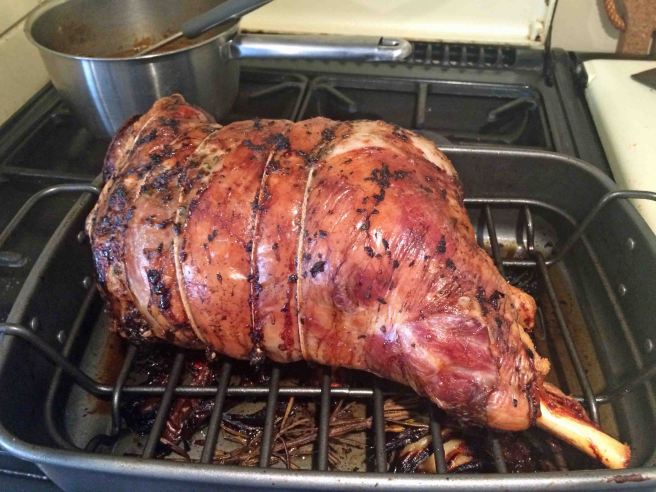
Take the lamb out of the oven and let stand for 20 minutes on the carving board while you prepare the gravy and finish off the vegetables.

lamb done.jpg

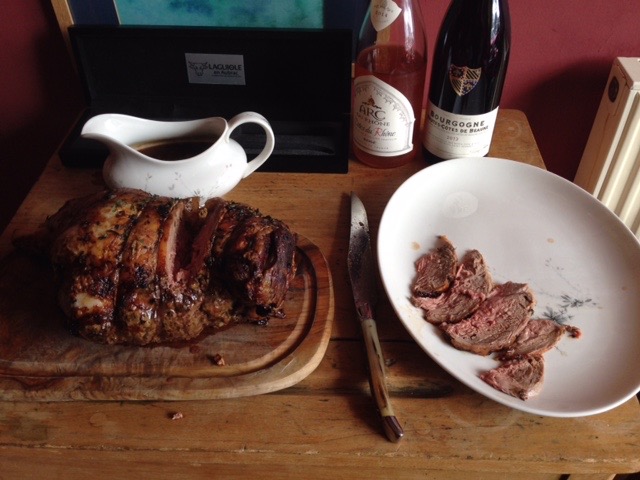
For the gravy DonQui uses his Rich Meat Sauce recipe (including the recurrent jelly) as the base. This he prepares well in advance. When the lamb is resting he deglazes the roasting pan with red wine and strains it into the gravy base. He also pours in the juices which collect in the channels on the carving board as the lamb rests.

IMG_0269.jpg

He serves with roast potatoes which he puts in the top of the oven at the half way point after the lamb has been cooking for 40 minutes. This gives them 60 minutes to get really nice and brown (the remaining 40 minutes cooking time plus the 20 minutes resting). DonQui is now quite proud of his roasties but it has taken him quite some time to master them. At some point he will write about his method.

For vegetables DonQui goes for a medley of baby carrots, fine green beans and baby corn. He parboils each for 4-5 minutes in advance. Then when the lamb is resting he swishes them around in a large pan with melted butter, salt pepper and thyme for a couple of minutes until they are well combined and nicely heated through.


Around the World in Chelsea

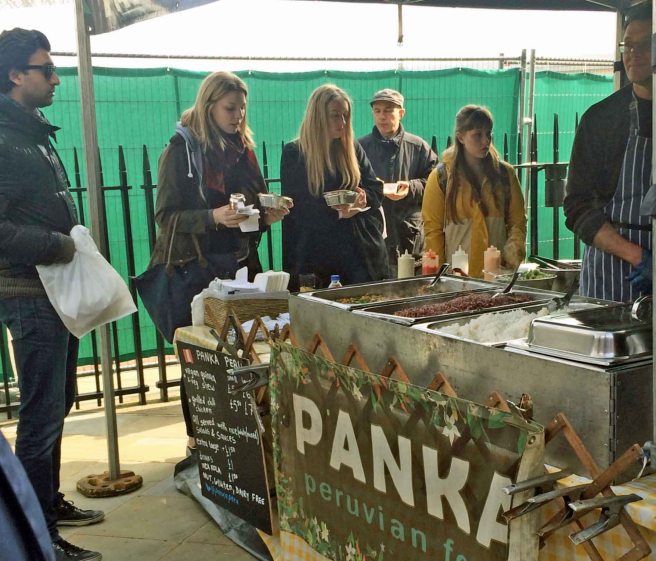
If you were to ask DonQui, he would tell you that one of the (many) great things about London is how cosmopolitan it is. People from every corner of the globe live and work here, and that means you can get just about every type of food imaginable.


IMG_6654.jpg

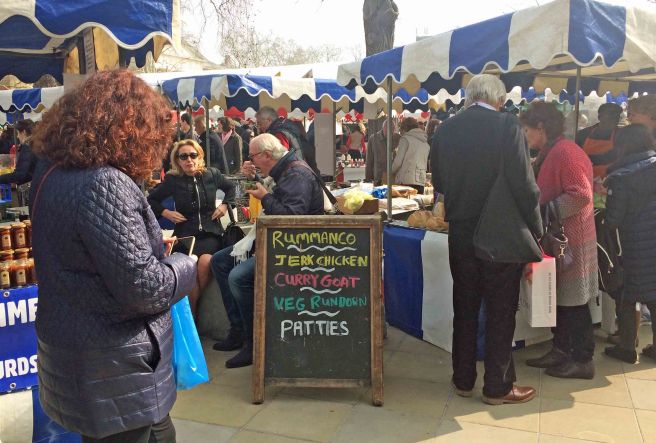
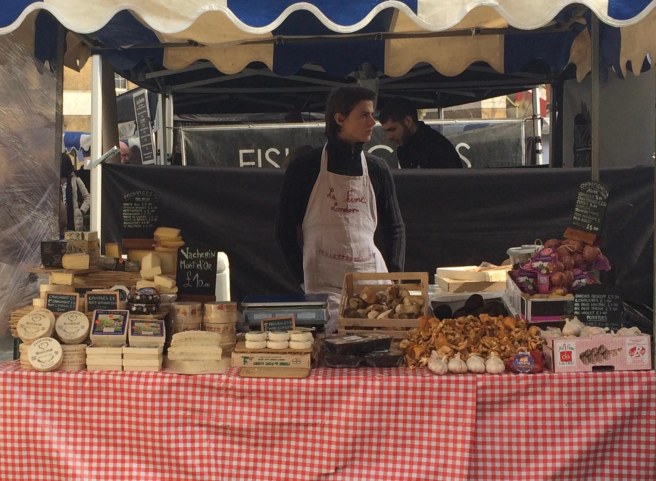
It is a Saturday late morning/early afternoon and DonQui finds himself in one of his favourite places to be at that time, especially on a nice sunny day – the fine food market at the Duke of York Square in Chelsea.

IMG_6666.jpg

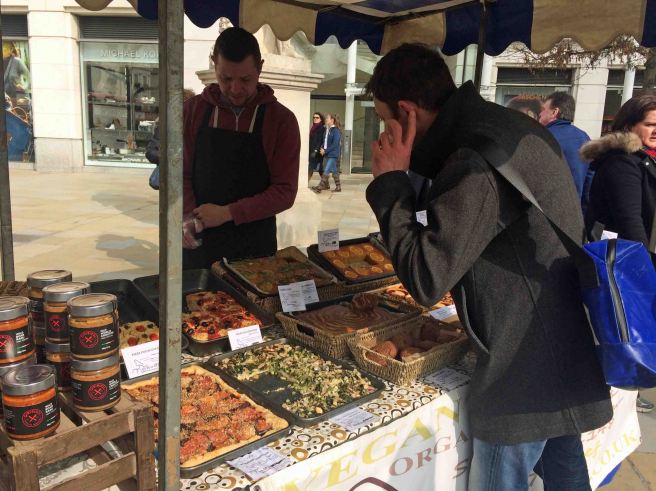
Helping himself to various free samples DonQui wanders around the stalls salivating.

IMG_6651.jpg

From fine French cheeses and proper baguette (made with French flour)…

IMG_6658.jpg

To chicken, rice, beans and quinoa  from Peru.

IMG_6644.jpg

Japanese sushi…

IMG_6648.jpg

to Mexican burritos…

IMG_6653.jpg

With so much delicious food on offer DonQui finds it very hard to settle on what to eat for lunch, let along what to take back home with him.

IMG_6670.jpg

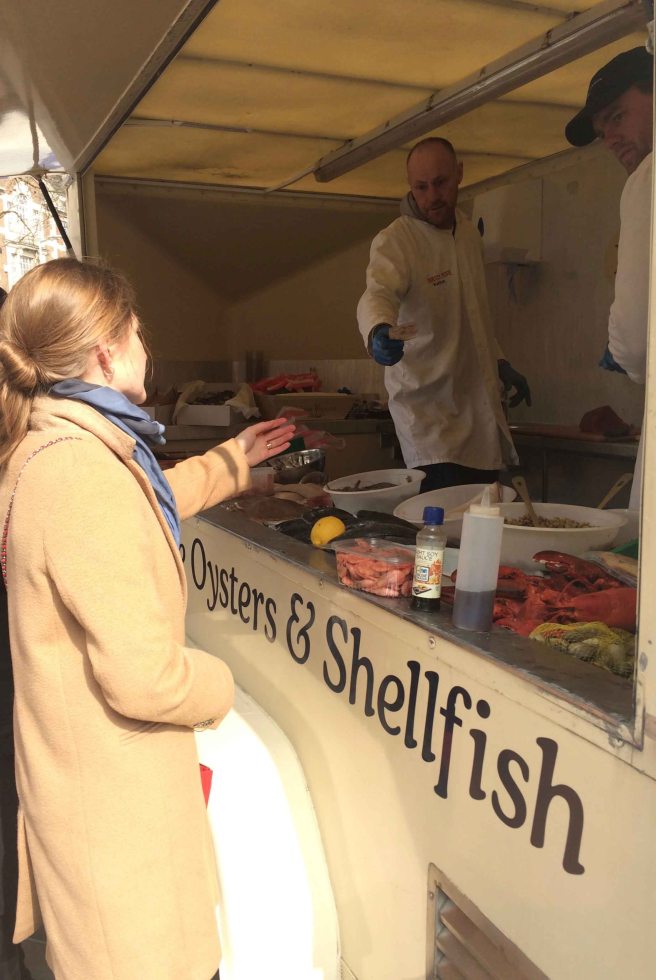
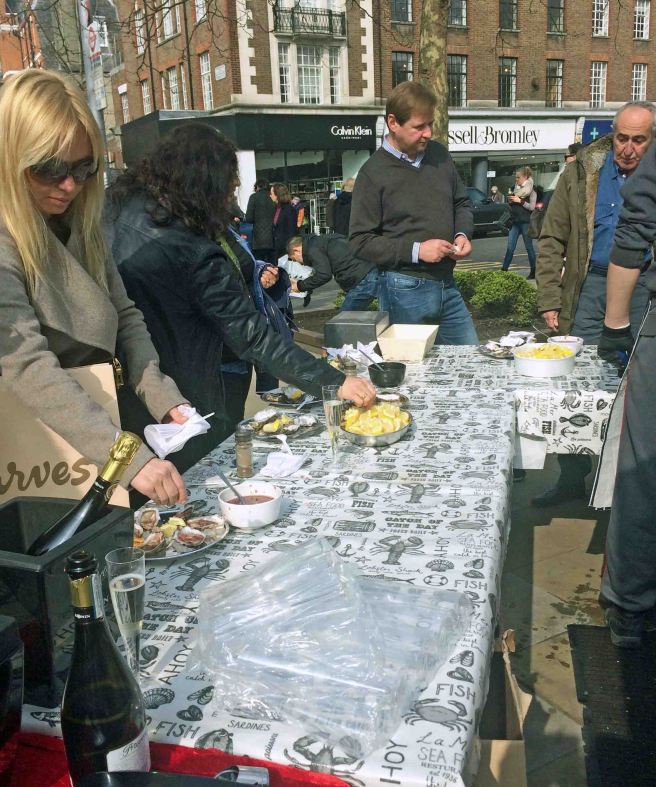
There are even fresh oysters and prosecco on offer.

IMG_6641.jpg

In the end DonQui decides to keep it simple. He goes for a Jamaican patty and a couple of Indian samosas for a small lunchtime snack.

IMG_6667.jpg

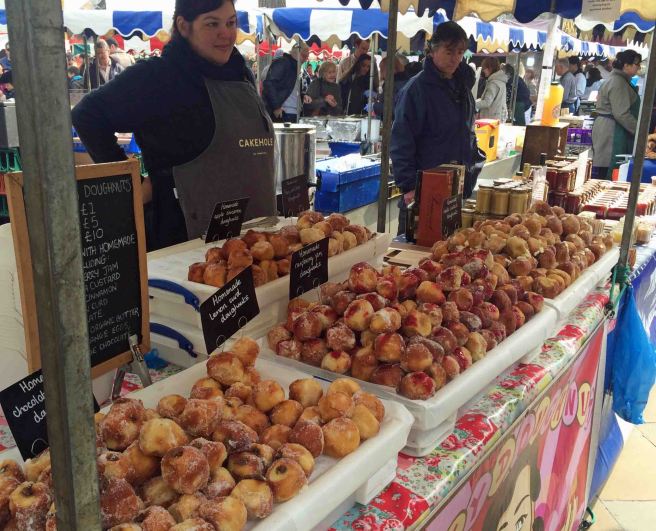
… oh yes and a jam doughnut too. He cannot resist!

IMG_6674.jpg

He also packs his bag with all sorts of goodies for later on when he gets home.


Soft on Cabbage

Oh dear!

It looks like DonQui Oaty – the great carnivore and scourge of  vegetarians everywhere –  is going a bit soft on cabbage.

Well not soft really.

If DonQui has a problem with vegetables it stems from 1960s English cooking and school dinners. Back then an alarming degree of softness was always obtained by boiling everything for a good 20 minutes or more. If DonQui is going to enjoy something that has sprung out of the ground rather than having run around on it, then it needs to still retain a good deal of crunch.

So soft vegetables will not do… mashed are even worse… but something keeping its crisp freshness… then DonQui can begin to consider it as fine food rather than compost.

IMG_6555.jpg

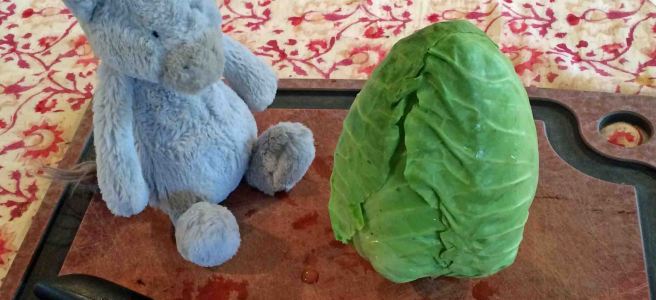
So first it was sauerkraut and now this – a rather perky looking small pointy-headed cabbage which DonQui found in his local farm shop. The helpful lady said it was a Hispi Cabbage and told him that it was utterly delicious.

“How do you cook it?” DonQui enquires.

Helpful lady replies, rather unhelpfully, that she steams it.

DonQui cannot help but think that there must be more interesting ways to deal with the pretty little cabbage, so he takes it home with him and scours the internet.

A recipe from Chef Adam Gray seems more like it. A quick 3 minute parboil followed by a stir-fry in butter and shallots seems much more interesting than a simple steaming. DonQui tries it out as an accompaniment to roast chicken and it works wonderfully. Duchess loves it but DonQui thinks it is still a bit too soft for his liking so he vows to try it again without the parboiling.

This is what he does:

IMG_6561.jpg

He finely slices a shallot, chops up some smoked speck (you can substitute lardons or dry smoked streaky bacon) and crushes a few juniper berries with the blade of his knife.

IMG_6566.jpg

Then, after removing the outer leaves, he cuts the cabbage into fine strips by slicing across with a knife. The leaves of the Hispi cabbage are tightly packed, making it ideal for this sort of treatment.

IMG_6563.jpg

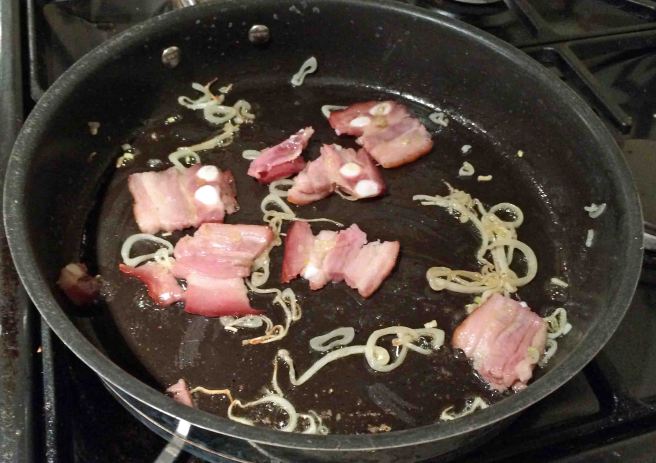
He stir-fries the speck and shallots in butter until they begin to colour.

IMG_6568.jpg

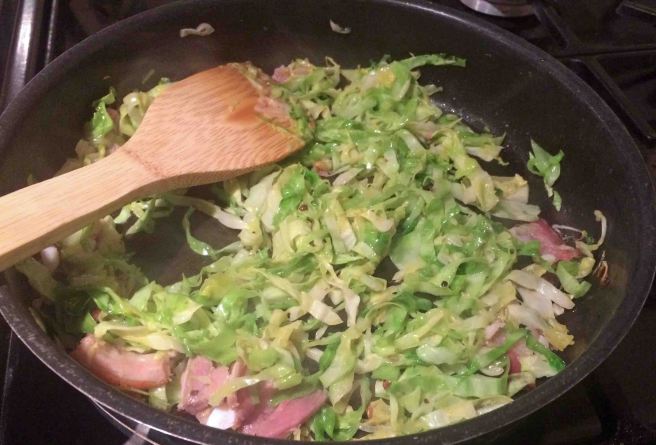
Then he adds the cabbage and juniper berries along with a few twists of black pepper from his pepper grinder. There is no need to add salt thanks to the saltiness of the speck.IMG_6569.jpg

He cooks it all together until it starts to glisten and begin to go soft. DonQui tastes to check doneness. When it looses its raw taste but still retains a good bit of crunch it is ready. This probably takes about 4-5 minutes.

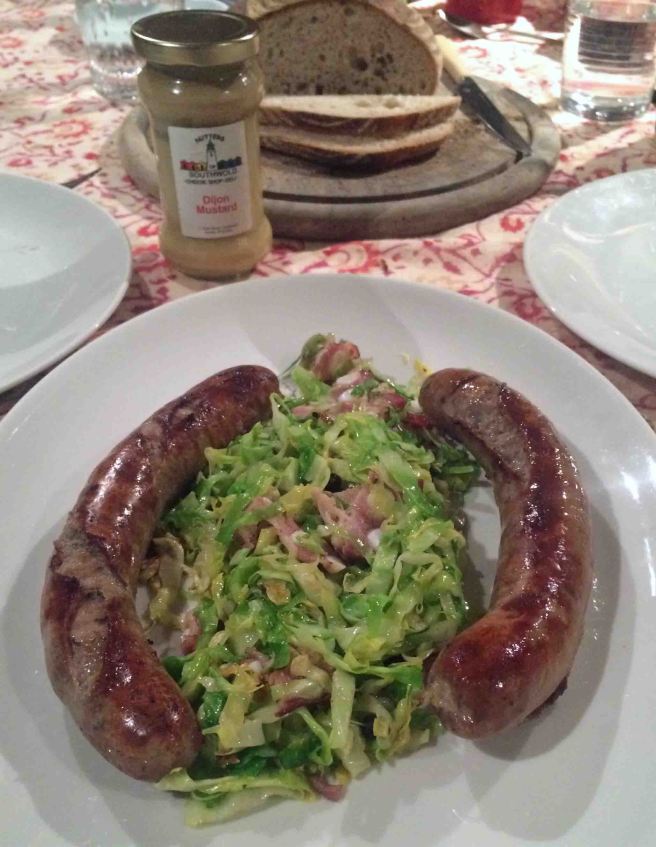
IMG_6570.jpg He serves it with a couple of bratwürst, mustard for those who like it (DonQui does not) and fresh sourdough bread.
Quick and dead simple to make – and rather yummy too, DonQui thinks.


Choucroute Garni

Having been a bit distracted by other things of late, DonQui has been a bit remiss in posting.

Fear not! Today he has the pots and pans out and is going to try to create a classic winter’s dish that he has never attempted before.

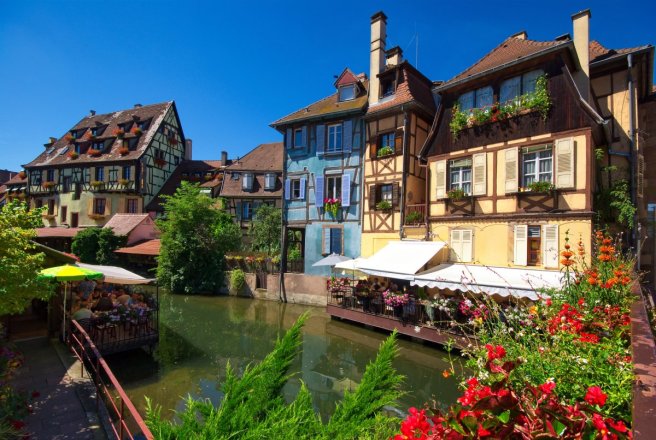
It all started when Duchess decided she liked sauerkraut. Now DonQui has a sort of love/hate relationship with sauerkraut. Properly cooked like they do it in the Rhine valley – simmered in Riesling with lots of smoked meats infusing it with their deep flavour – then it is love. Taken straight from the jar and still sour, or cooked with caraway seeds, then it is hate.   To be certain, to get the sort of sauerkraut he loves then there was no doubt that he would have to prepare it himself.

Alsace.jpg

So after searching through a myriad of different recipes and casting his mind back to the tastes he remembers from meals he had in Alsace and Baden, DonQui creates his own version of Choucroute Garni. This roughly translates as “Dressed up Sauerkraut” –  Choucroute being a gallicisation of Surkrutt , the word used in the local dialect on both sides of the Rhine for sauerkraut.

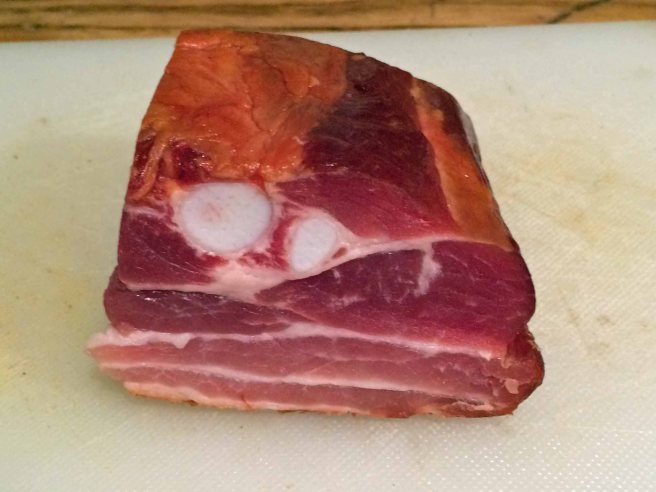
One of the hurdles DonQui had to overcome was to find suitable smoked meats and sausages to give the right flavour. Heavily smoked bacon, pork and proper German style sausages are really hard to find in Britain. The influx of recent Polish immigrants may help in the future but for now DonQui was going to have to rely on doing some online shopping.

Melbury and Appleton furnished authentic Frankfurters and Bratwürste  (DonQui put the latter aside for another day)

Speck.jpg

The German Deli came up with the all important Geräucherter Speck (smoked pork belly) as well as Kassler (smoked and cured pork loin) and some Schwarzwälder Schinken (Black Forest Ham)

Black Forest ham.jpg

For those who don’t know, real Black Forest ham is like a super smokey version of Italian dry cured Parma ham. What is peddled under that name in some other countries (especially in North America) is nothing like it.

So to the Recipe for 2 people. More people will allow a greater variety of meats:

About 250-300g Sauerkraut, depending on size of appetite
A good piece of smoked Speck cut into 1cm wide chunks (although nothing like as good, smoked lardons, available from supermarkets in the UK, can be a reasonable substitute)
1 thinly sliced carrot
1/2 a finely chopped onion
butter mixed with a bit of duck or goose fat or dripping
1 bay leaf
around 10 peppercorns (DonQui used soft pink peppercorns for their delicate flavour and so as not to loose a filling when biting into one)
around 8 juniper berries (a few more or less do not matter)
about 200 ml Alsatian Riesling (no other wine works quite as well)
about 100 ml non-salted chicken stock (leave this out if you cannot find an unsalted version otherwise, with the addition of the cured meats the taste will be far too salty).

A selection of smoked and cured meats such as:
Smoked sausages (at least 1 or 2 per person — DonQui used 2 long frankfurters which he cut in half)
Kassler or smoked gammon (DonQui used the former)
Smoked Black Forest ham (Next time DonQui would leave this out as unnecessary)
Pork Knuckle (Not used this time)
Confit Duck legs (Not used this time)
Smoked pork ribs (Not used this time)

Method

Drain the sauerkraut and soak in cold water for 15 to 20 minutes. Squeeze out as much water as possible. Pick it apart to separate the strands.

Preheat oven to 180 degrees.

Stir-fry the speck, carrots, and onions in butter/fat slowly in a casserole for 2-3 minutes until they begin to colour. Then cover and simmer for around 8 minutes.

Add the sauerkraut and when it is well covered with the fat and vegetables, cover and cook slowly for 10 minutes more.

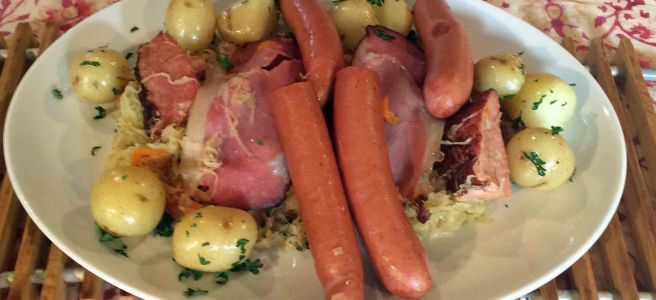
Choucroute Garni.jpg

Add the herbs and spices. Pour in the wine, and enough stock to just cover the sauerkraut. Add the kassler or any other uncooked meats that will benefit from a long simmer. Cover, bring to the boil then put in the middle of the preheated oven. Turn down to 160 degrees and then let it cook slowly for 2-3 hours. Check every once in a while and if it is beginning to dry out add a splash more wine.

Twenty minutes before serving add the frankfurters to the pot or any other meats that need a little less cooking such as duck confit if you are using it. If you want to try using bratwürst then it is better to fry or grill them and add them at the last minute.

At the same time boil some potatoes. When they are done, swish them around in butter and add some chopped parsley

Five minutes before serving add the Black Forest Ham to heat through and allow its smokiness to permeate the dish. Next time DonQui will leave this out as he did not think it quite worked.

choucroute garni 2.jpg

Served with the sauerkraut heaped on a plate with the meats draped over it and surrounded by the boiled potatoes, it met with Duchess’ approval.

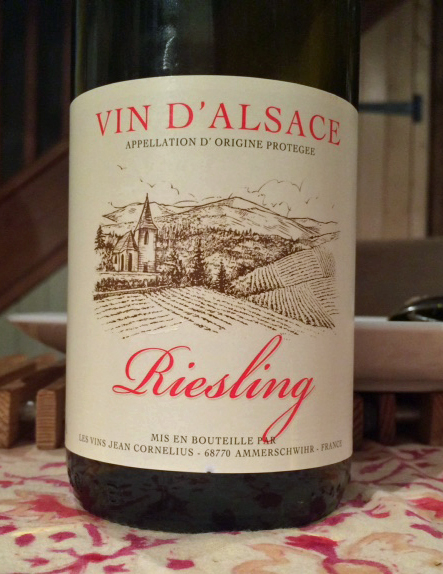
Riesling.jpg

Wash it down with the rest of the Alsatian Riesling (chilled)


Rules

Before going off to see the antics of Nell Gwynn and Charles Stuart, DonQui thought it would be a good idea to have a proper lunch.

Rules 1.jpg

And what could be more appropriate than Rules — possibly London’s oldest restaurant although the title is contested by Simpson’s Tavern and Wilton’s.

Opening in 1798, Rules is probably the closest one can get to a restaurant of Nell’s time, not that they really existed back in the 17th century. Nell would have frequented taverns but the concept of a ‘restaurant’ did not really come into being until after the French Revolution. One theory is that in the revolution the chefs of headless aristocrats found themselves out of work and therefore started to set up on their own.

Started as an oyster bar by Thomas Rules it then expanded to include more substantial fare. Contemporary writers mention ‘rakes, dandies and superior intelligences who comprise its clientele.’

Just the sort of place for me’, DonQui thinks.

Serving proper food such as roast beef and Yorkshire pudding, rack of lamb, pies and a wide variety of game, Rules is not the sort of place to bring a vegetarian, some Californian on a weird faddish diet, nor someone who is in a hurry. It is the sort of place to go to if you are looking for a long leisurely meal and old-school atmosphere.

DonQui booked in for a late lunch at 3:30, leaving plenty of time to build up an appetite before, and plenty of time to linger afterwards. He was surprised that even at this hour the place was full, with waiters in black and white weaving their way around tables of casually well-heeled patrons.

Rules 2.jpg

With a lovely glass of bubbly Crémant de Bourgogne to sip on while he contemplated the menu, DonQui sees that meat from rare breed, slow maturing cattle is on offer. With Duchess on hand to help out, rib of beef for two seemed just the ticket.  After an appetite warming partridge salad to start with, DonQui was ready for the main event.Rules 4.jpg

Although he was well aware that Rules tended to go for old fashioned large portions, he was not quite prepared for just how much food arrive at the table.

It certainly looked good. So DonQui took a sip of Côtes du Rhône to fortify himself, girded his loins, and prepared to do battle.

Rules 5.jpg

The beef, served along with the bone it was carved from, was delicious with a nice charred, salty outside while remaining rare in the middle. Ordered medium-rare it was on the rarer side of medium which was fine for DonQui but a little too visceral for Duchess. Fortunately there were sufficient outside pieces of greater doneness which suited her tastes. The Yorkshire puddings were magnificent as were the accompanying spinach and dauphinoise potatoes. DonQui is not keen on horseradish but Duchess, who is, assured him that it was creamy with just the right amount of bite.

Service was professional, helpful yet unobtrusive and the bill was… well… as magnificent as the food. Even by London standards Rules is not cheap, but then it is an experience as much as a place to eat.

Resolutely old-fashioned and English, in DonQui’s opinion Rules is a wonderful respite from the modern world’s obsession with the new, fast and transient. It is well worth saving up a few shekels for the occasional visit.

Homemade Cranberry Sauce

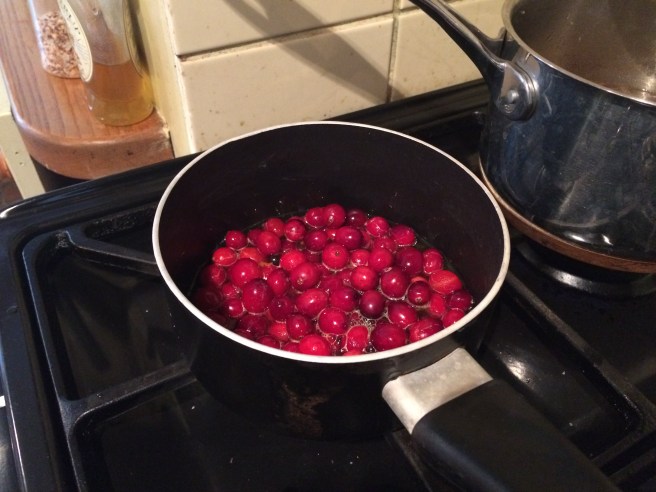
Much to DonQui’s surprise this is really easy to make. He first tried it out over Christmas and more recently to accompany his guinea fowl supremes.

IMG_6328.jpg


Ingredients
200g fresh cranberries
Juice of 1 orange plus a bit of zest
Sugar to taste (DonQui likes his quite tart while Duchess likes it sweeter)
A good splash of ruby port

Method

IMG_6325.jpg

Put all the ingredients except the port in a small pot. Bring to the boil and then let simmer gently until the cranberries turn soft and the liquid reduces down.

IMG_6327.jpg

Add a splash of port. Taste for sweetness.

And that’s it!


Guinea Fowl Supremes

Looking for something interesting for dinner, DonQui rummages around the corners of his freezer. There, underneath some frozen beans, he finds a pair of guinea fowl supremes which he picked up from the wonderful Wild Meat Company at the Aldeburgh Food and Drink Festival last September.

Thinking that these will do the trick DonQui pulls them out to thaw and then looks around for advice on how to cook them.

guinea-fowl.jpg

Guinea fowl is a lot like chicken. It has a relatively delicate white meat without any of the gaminess of pheasant, partridge or grouse. DonQui has roasted a whole guinea fowl before but not supremes.

g-f supremes.jpg

The supreme is the breast of the bird off the bone but with the first wing joint still attached and the skin on. Mr Google advised first frying and then finishing off in the oven. This is what DonQui decides to do and he is delighted with the result.

This is his recipe:

Preheat the oven to 200º

onion fry.jpg

Lightly brown a very finely sliced onion or a couple of shallots then put them into a roasting tray with a good splash of white wine.

Make sure the supremes are completely dry (this will ensure a nice caramelised outside), season with salt and pepper and then fry skin side down in the same pan. Fry gently for about 3 or 4 minutes until nice and golden brown then turn over and seal the other side.

Swish out the pan with white wine and add to a gravy base (see DonQui’s earlier post: Rich Meat Sauce)

roast tray.jpg

Turn down the oven to 160º, place the supremes skin side up in the roasting tray on top of the shallots, sprinkle with rosemary (or you can also use tarragon for a slightly different flavour). Cook uncovered for about 12 minutes.

g-f roasted.jpg

Let rest for 4-5 minutes while you finish off the vegetables. Pour off the juices into the gravy.

guinea foul finished.jpg

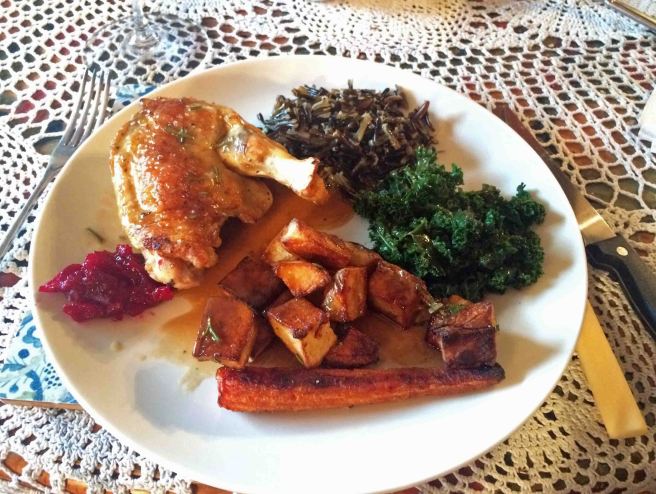
DonQui served his with curly kale, roast carrots, wild rice and parmentier potatoes (roast potato cubes); gravy and homemade cranberry sauce (very easy to make and may be the subject of a future post).

moulin a vent.jpg

DonQui recommends a light red wine to go with it. This Moulin-à-Vent was just about perfect.

The January Blues

January is generally regarded as the most depressing month of the year. DonQui, however, rarely has too much trouble with it, probably because he never bothers to set any New Year’s resolutions which might curtail his enjoyment of life. Indeed he is writing this now in a pub with a nice pint beside him after just having devoured a rather good beef burger and fries.

IMG_6213.jpg

Today’s papers brought the news of David Bowie’s death alongside the usual depressing stuff from the Middle East and the evil antics of religious nut-cases world wide. If this is not bad enough DonQui comes across an article describing a new movement designed by puritanical spoil-sports to ensure we expunge even more fun from our lives.

Alongside the ghastly proposition of dry January (staying off booze rather than stopping the rain)  comes the even worse idea of veganuary. This latest moralising fad proposes that we should become vegans for the month of January allegedly to improve our health and save a few cute cuddly animals.

360_vegetarian_0402.jpg

Now DonQui’s view of a proper vegetarian option is similar to that of a good French restaurant — choose fish or poultry as an alternative to meat. He has known a few vegetarians in his life and he may have seen a vegan or two passing along in the street looking gaunt, joyless and as if they were in need of a proper meal to give them a bit of colour. Hitler was a vegetarian while Churchill freely enjoyed many vices— meat, alcohol and tobacco amongst them.  DonQui is in no doubt of which  man he looks up to.

There have been days when DonQui has not eaten any meat but this was because a nice mushroom risotto might have taken his fancy rather than a conscious desire to avoid animal products on moral or health grounds.

If the puritans had their way, not only would we all be more miserable but the livestock would be too — or they might not  exist at all.

maxresdefault.jpg

The cute piglet in the veganuary advert would not go to market if the moralists gain the ascendancy. He would be killed and incinerated as the farmer could not afford to keep him alive just to decorate the countryside. This is what happens to hundreds of thousands of male calves each year in the UK since for some reason Brits are squeamish about eating veal and the animal rights brigade destroyed the export industry. With no market the male calves are simply destroyed and thrown away.

Although DonQui may be a simple creature he struggles to see how this could be considered a moral outcome or a good for our planet’s dwindling resources.

So as he consumes a second pint DonQui resolves to continue to drink alcohol, eat meat and generally to enjoy all that life has to offer.

The January blues be damned!

Duck with Cranberry and Orange Sauce

DonQui has been rather lazy over the past few weeks but then that is what the Winter Solstice is all about — a fire burning in the hearth to keep him warm on the outside and calvados or port to keep him warm on the inside.

With a belly full of turkey DonQui has not been particularly inclined to do much cooking of late but today he decided it was time to get the pots and pans out again and eat something other than cold cuts and salad.

In the freezer was a large duck breast DonQui had bought in France a few months back. In the fridge were some left over cranberries which he did not use with the Christmas turkey. Therefore duck breast with cranberry sauce seemed to be the way to go.

Here is his recipe for 2 people:

Ingredients
For the Meat
1 large duck breast
6 juniper berries
3 allspice cloves
Salt and freshly ground black pepper to taste
a tiny pinch of ground cinnamon

For the Sauce
100 ml ruby port
100 g fresh cranberries
Finely grated zest and juice of 1 orange
½ cinnamon stick
250 ml chicken stock
2 teaspoons of redcurrant jelly

Method

IMG_6172.jpg

Score the skin of the duck breast with a sharp knife cutting all the way through the fat but not into the meat.

IMG_6176.jpg

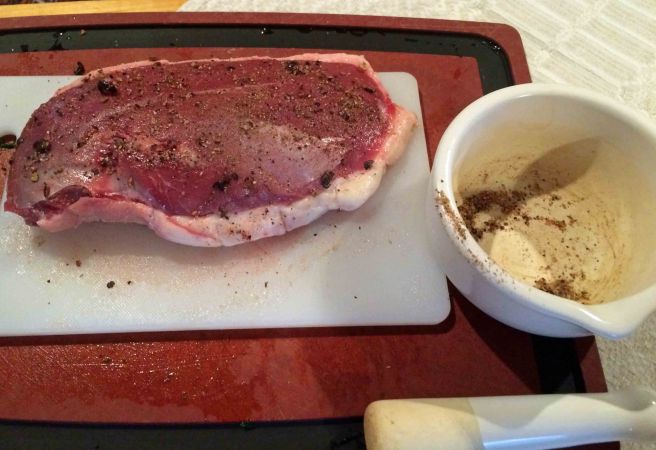
With a mortar and pestle, grind the juniper berries, allspice, salt, pepper and cinnamon into a rough powder. Rub the mix all over the duck breast and leave to stand for about 10-15 minutes.

IMG_6179.jpg

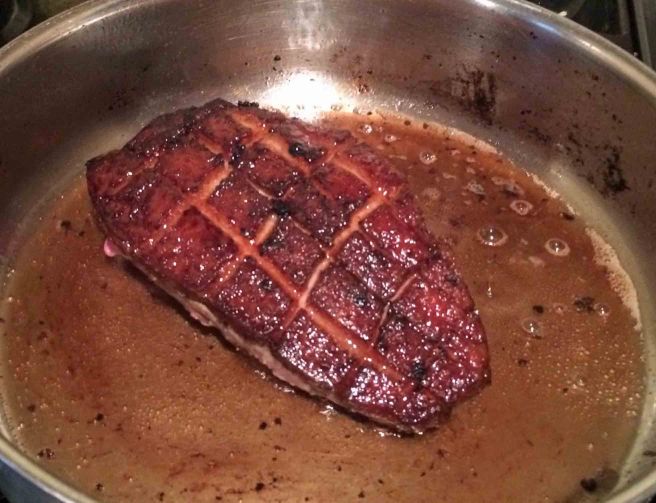
Gently fry the duck breast, skin side down, in a dry heavy-based pan for about 10 minutes. The idea is to let all the fat cook out, leaving the skin nice and crispy. Then turn the breast over and fry the other side for about 4 minutes. Set aside to rest while you make the sauce. It will need a good 10 minutes resting time.

Pour off excess fat from the frying pan, there will be a lot of it, but try not to loose the meat juices. If you managed not to burn it then you can keep it in a jar to use later for roasting potatoes

IMG_6180.jpg

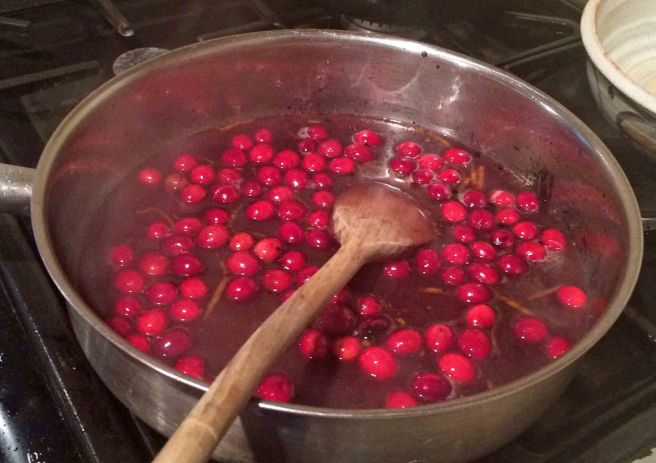
Deglaze the pan with the port then add the remaining ingredients for the sauce.

IMG_6185.jpg

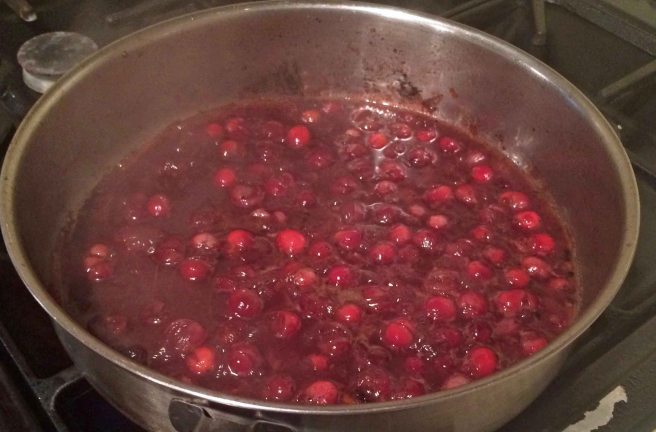
Bring it to the boil and let it cook down until it is reduced by about two-thirds and had thickened to a syrupy consistency and the cranberries are very soft.

Add the juices from the resting duck. Taste and adjust the seasoning and add a little sugar if you think it is a little too tart.

IMG_6183.jpg

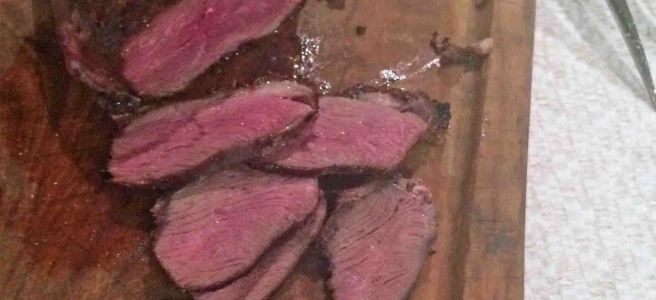
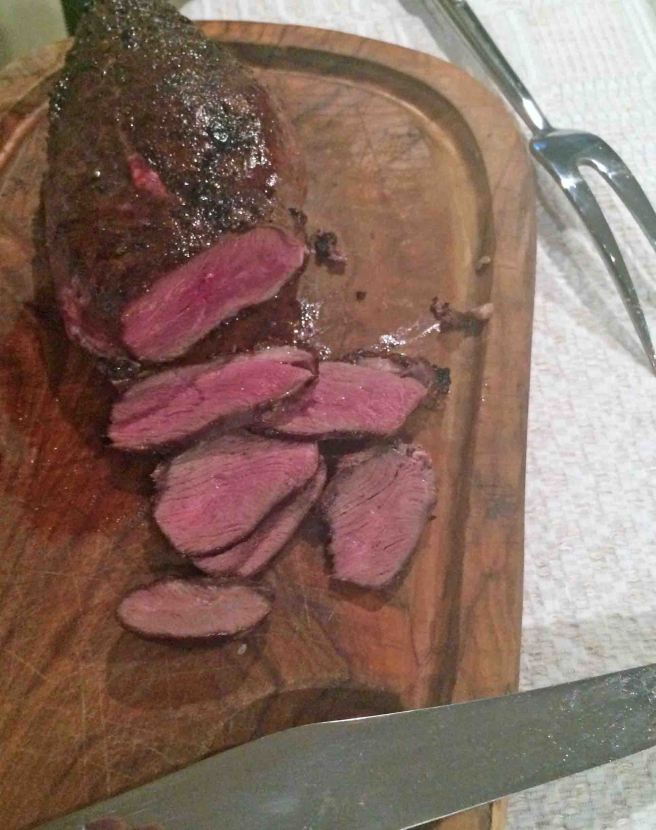
Thinly slice the duck breast and serve with the cranberry sauce spooned around it. DonQui had roast potatoes and black kale to accompany it.