Wild Mallard

Duck is one of DonQui’s favourite meats. He is also very fond of game.

Imagine his joy, therefore, at seeing a wild mallard duck at his local butchers. It was too much to resist so he picked it up, took it home and then did a bit of research on how to best cook the bird — this being his first attempt.

mallardusfwerwinandpeggybauer.jpg

A wild mallard is much smaller than a farmed duck — just about perfect for two people. It also has very little fat. Unlike a domestic duck, there is no need to render the fat and the whole bird can be roasted rather than separating the legs and breasts. Because the bird is so small the best way to prepare it is by browning it all over in a hot pan and then finishing it off in the oven.

This is DonQui’s recipe.

ingredients.jpg

Ingredients for the roast mallard for two people
1 wild mallard
1 onion quartered
2 carrots roughly chopped
1 garlic clove peeled and halved
1 lemon cut in half
A good bunch of fresh thyme
Salt
Oil and butter for cooking

Accompaniments (all optional)
1 apple cored and left whole with the skin on
Butter, raisins and a splash of rum to fill the inside of the apple
A handful of dried porcini mushrooms, soaked for at least 30 minutes
A good splash of red wine to deglaze the pan
Wild rice
Seasonal vegetables
Cranberry sauce

Method
Take the duck out of the fridge at least one hour before cooking so that it comes to room temperature.

Pre-heat the oven to 200º C. Meanwhile rub sea salt all over the duck, including the cavity. Salt on the skin will help to crisp it as well as adding flavour.
raw veg.jpg

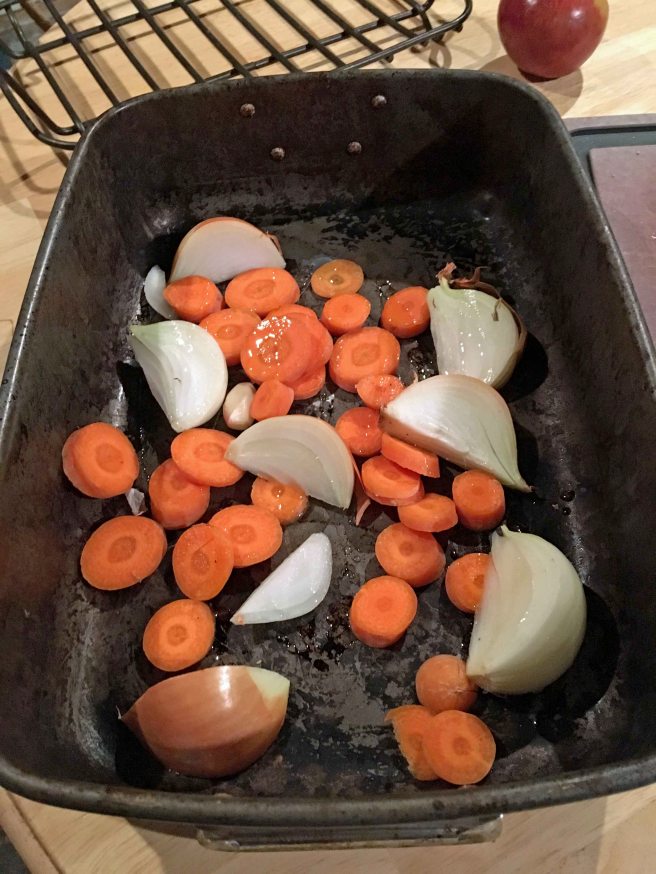
Place the quartered onion, chopped carrot and garlic in a roasting pan, douse with a little oil and place in the heated oven to roast for 30-45 minutes until the vegetables are nice and dark but not burned.
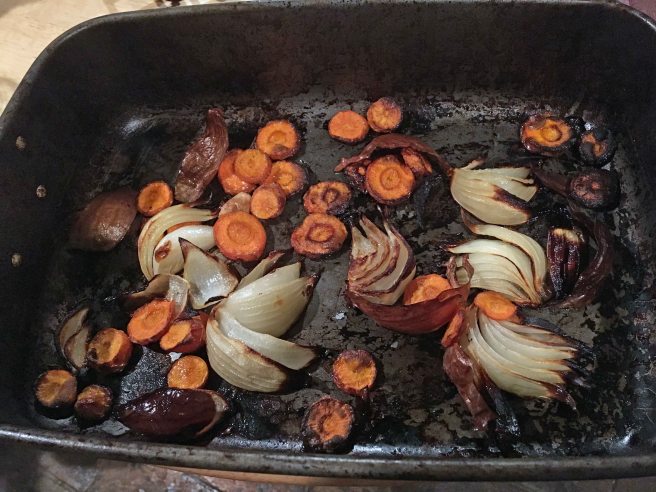
pre-roast veg.jpg

As the roasting time for the duck is only 12-15 minutes, DonQui does this in advance to help create a deep rich sauce. Otherwise the vegetables will not imbue the dark roasted flavours to the sauce. Take the vegetables out of the oven once they are nicely roasted and set aside.

Put the soaked wild rice on to boil and then simmer about 45 minutes before serving. DonQui’s method for cooking wild rice is fully explained here. Once cooked the drained rice can happily sit in a lidded pot, off the heat, and will remain warm for at least 15 minutes if you do not get your timings right.
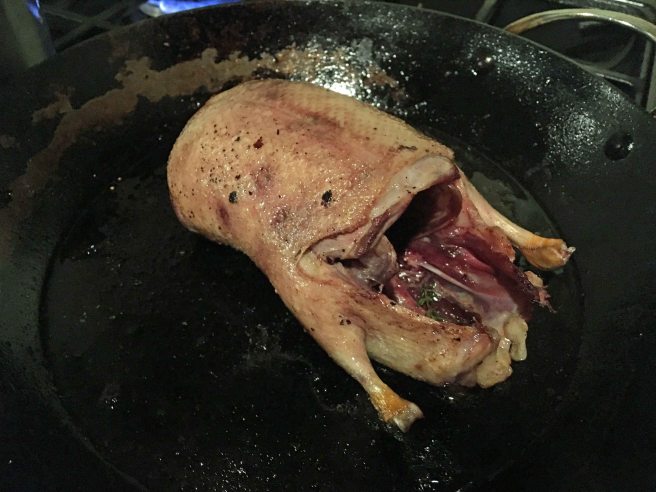
brown in pan.jpg


Once the vegetables are out of the oven, heat a mix of butter and oil in a large, heavy frying pan. Butter will give flavour and the oil will prevent it from burning. Brown the duck on all sides using tongs or a large spoon and fork to turn it. This will take about 10 minutes.

Take the bird out of the pan. Place it on a rack above the vegetables in the roasting pan. Then stuff the cavity of the duck with the halved lemons and sprigs of thyme. This will add flavour to the bird and the lemon will steam it from the inside while it roasts. Add the cored apple stuffed with butter, raisins and rum to the rack.

Put the roasting pan with the duck and apple above the vegetables into the oven and roast for 12-15 minutes. After 15 minutes the meat will still have some pink to it but more than that will cause it to dry out and toughen up. Twelve minutes will be just enough to cook through leaving the meat a little rarer.

finished 2.jpg

Place the duck on a carving board, cover with tinfoil and a couple of tea-towels (dishcloths) and let it rest for 10-20 minutes. In this time the duck will continue to slowly cook from the inside out. This will even the cooking process which up to now has been from the outside in. If you do not rest for at leat 10 minutes the meat will not be properly cooked.strain.jpg

Cook the accompanying vegetables and make the sauce while the duck is resting.
To make the sauce, deglaze the roasting pan with a good splash of red wine over the roasted vegetables, stirring it all up over a low heat and scraping up the brown bits. Then strain the liquid into a pre-prepared gravy base. As the wild duck has very little fat there is no need to spoon anything off.

DonQui’s gravy base is a variation of his rich sauce. A simple alternative could be chicken stock thickened with a roux of butter and flour.mushrooms.jpg

On this occasion DonQui decides to add some dried porcini mushrooms. As the duck is roasting he pan fries the soaked mushrooms in a butter-oil mix, using the same pan he browned the duck in without cleaning it. Then he adds them to the sauce along with the water they had been soaking in. This gives the gravy a deep earthy taste which perfectly matches the wild duck.
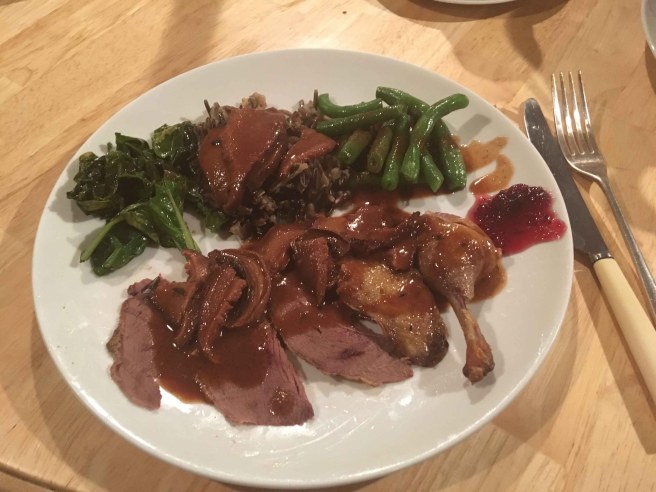
plated.jpg

DonQui serves the duck with the wild rice, fresh kale from his allotment and french beans. Although not seasonal, he had picked the beans in season and froze them a few months ago. They were an excellent additional accompaniment.

As for the mallard — it was utterly delicious. DonQui will definitely try it again. Next time he will not bother with the baked apple. It is a traditional addition to a game bird, and went well with it, but DonQui thought the cranberry sauce was better and there was no need of two different sweet accompaniments.

DonQui advises looking out for pellets when eating a wild bird.  He found three shotgun pellets in this mallard. He takes this as a good sign that the mallard will have been living freely as a wild bird should before succumbing to the hunter rather than the abattoir.
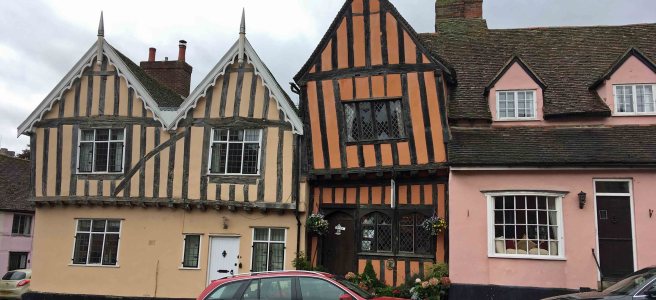
 

Harry Potter and Boots of Beer

IMG_0602 lr.jpg

Lavenham, Suffolk, bills itself as England’s best preserved medieval town. As a bit of a history buff it is a place DonQui has wanted to visit for some time. Even though it is not far from his home paddock on the Suffolk coast, he has not managed it until now.

IMG_0589 lr.jpg

In the heart of Suffolk, not too far from Bury St. Edmunds, Lavenham is not easy to find. There are no main roads and no rail lines. To get there DonQui has to wind his way along narrow country lanes with only just enough room for two cars coming in opposite directions to squeeze past each other. Perhaps this is why the place is so well preserved.

IMG_0615 lr.jpg

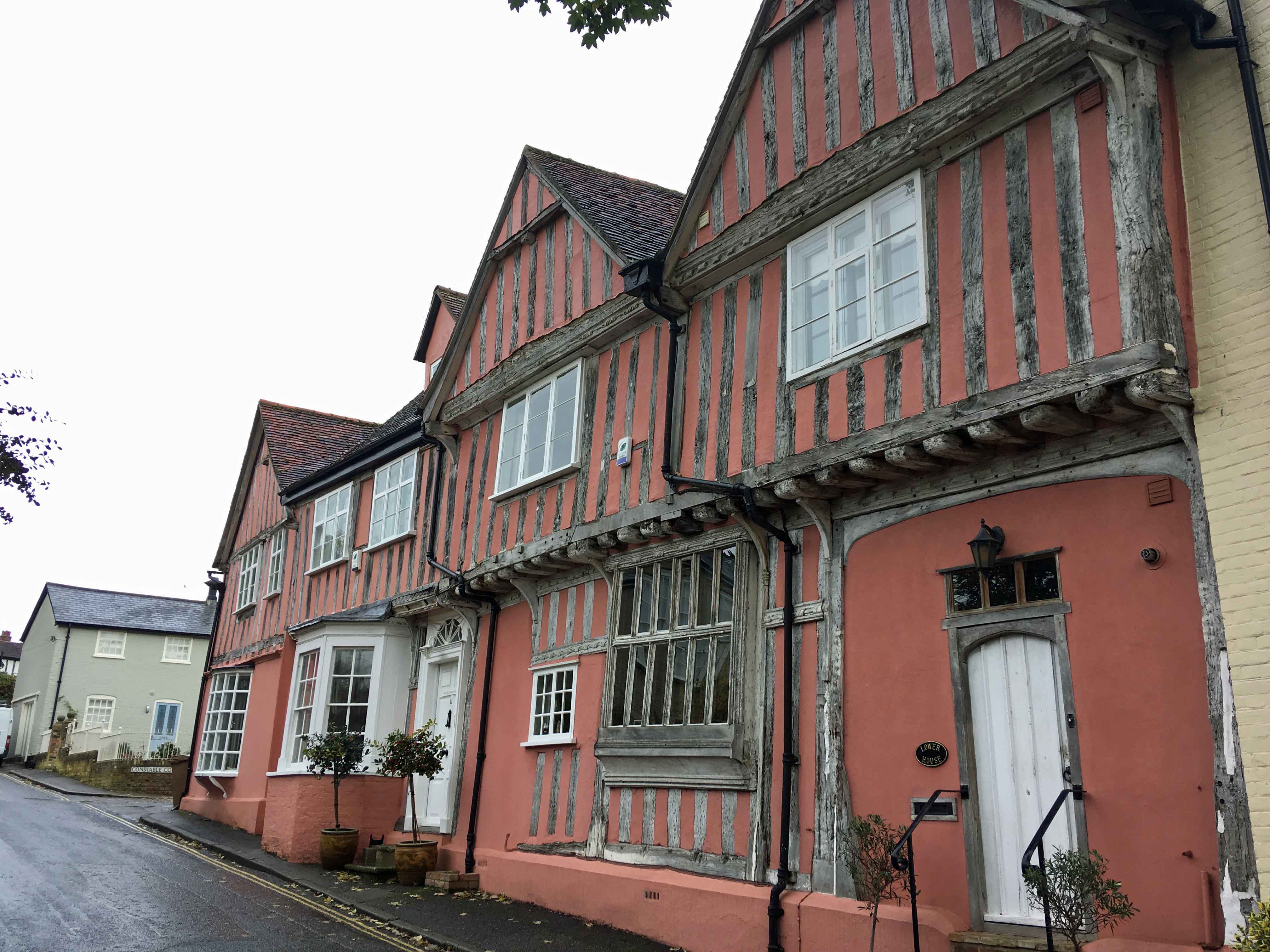
If you like old timber-framed houses this is the place for you. Many of the wonky buildings have been standing since the 14th century. Walking around the compact streets DonQui feels as if he has stepped back in time — parked cars notwithstanding.

IMG_0595 lr.jpg

Fans of Harry Potter may well recognise the De Vere house as Harry’s birthplace from the film The Deathly Hallows.

IMG_0625 lr.jpg

Several other films have also used the backdrop of Lavenham’s medieval streets as a backdrop.

IMG_0604 lr.jpg

Many of the houses have pink plaster. The colour is still known today as ’Suffolk pink’. Originally this colour was obtained by mixing pigs’ blood with the plaster. DonQui assumes that the modern versions are more likely made by chemical combinations to match the natural original.

1431742481665-garden-party-resized 2.jpg

Most of the buildings can only be admired from the outside but the Guildhall can be visited. It has been restored inside along with some excellent exhibits of its origins in the Flanders wool trade.

IMG_0567 2 lr.jpg

Later it became a house of correction where the ‘idle and disorderly’ (poor and homeless) were incarcerated in the misguided idea that hard work and cruel conditions would make them more productive members of society.

IMG_0568 lr.jpg

These reproductions of original notices give DonQui an idea of the fate of those unfortunates. One woman was incarcerated for having brought two children with smallpox into the town.

IMG_0564 lr.jpg

There is also a bit of relatively modern history to the place. RAF Lavenham was an active airfield during the second world war and was home to the USAAF’ s 487th Bombardment Group which flew 185 missions between May 1944 and April 1945 with the loss of 233 lives. The Airmen’s Bar in the Swan Hotel is dedicated to their memory.

IMG_0558 lr.jpg

Original graffiti from British and American pilots adorns the walls along with modern additions from returning veterans and their offspring.

Das-Boot_Beer.jpg

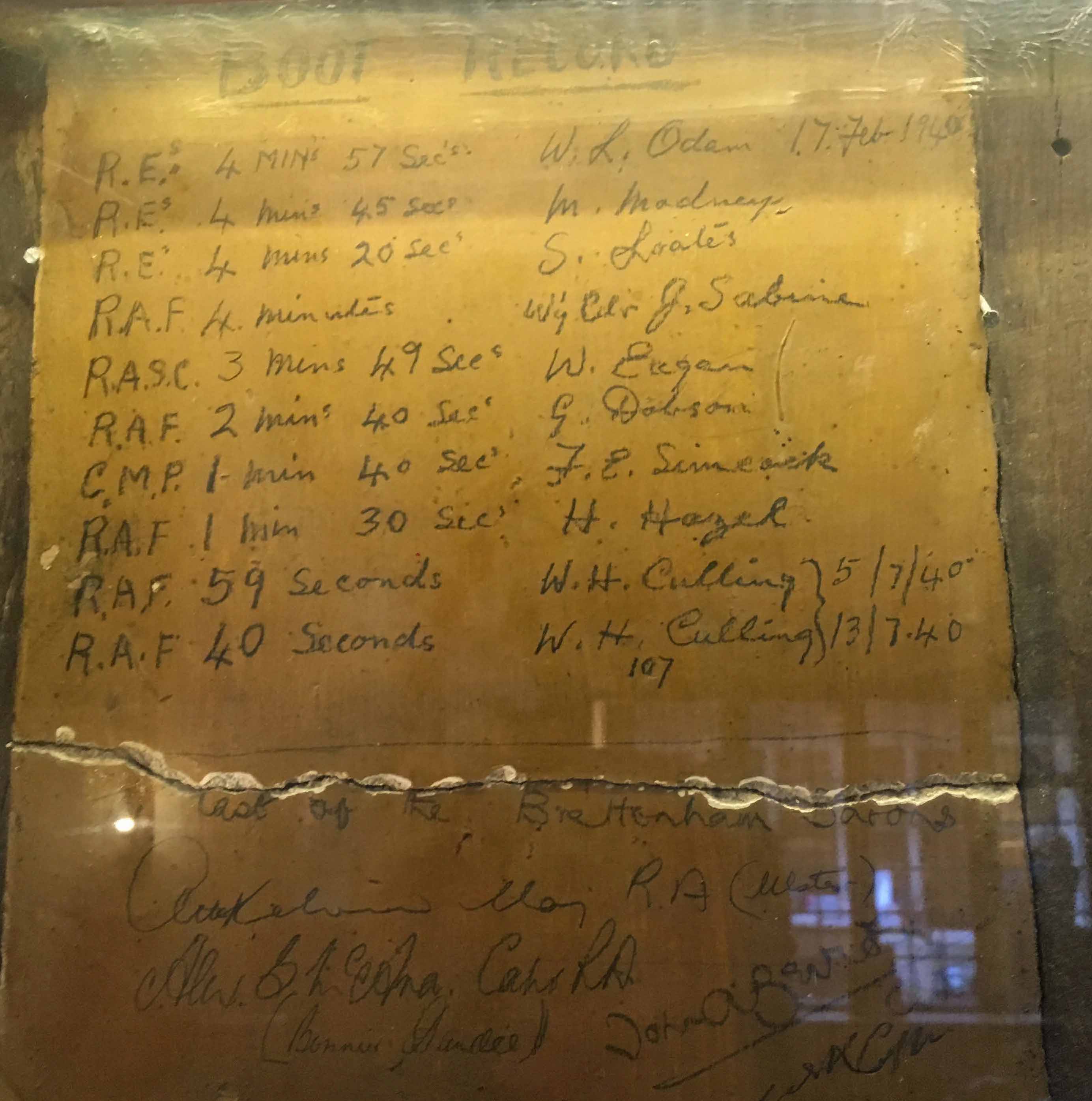
DonQui particularly likes the ‘boot record’ from 1940 which lists the times it took various British servicemen to drink a ‘boot’ of beer. Ironically this is a German tradition in which a couple of litres of beer are drunk in one go from a glass in the shape of a boot. DonQui did this in his younger days when he was living in Germany. The trick is to keep the toe of the boot pointing down otherwise an air-bubble will cause the drinker to be drenched, much to the amusement of the on-lookers.

IMG_0557 lr.jpg

DonQui takes his hat off to W.H. Culling of the RAF who drank the boot in an incredible 59 seconds on 5 July 1940 only to do it again eight days later in 40 seconds!

Lavenham has plenty of excellent watering holes. These include:

IMG_0536 lr.jpg

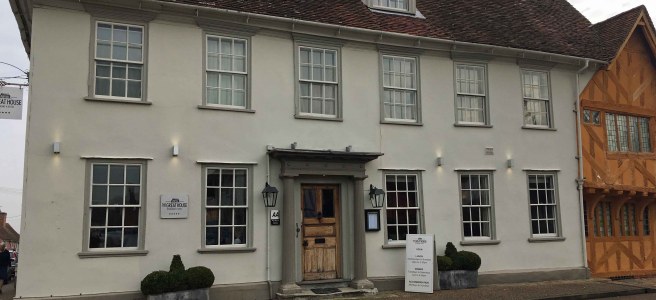
The Great House. This is where DonQui stayed and he reviewed it fully in his previous post. As boutique hotel with only 5 rooms it must be reserved well in advance. If you cannot get a room there, DonQui recommends treating yourself to at least one meal in the wonderful French restaurant.

IMG_0613 lr.jpg

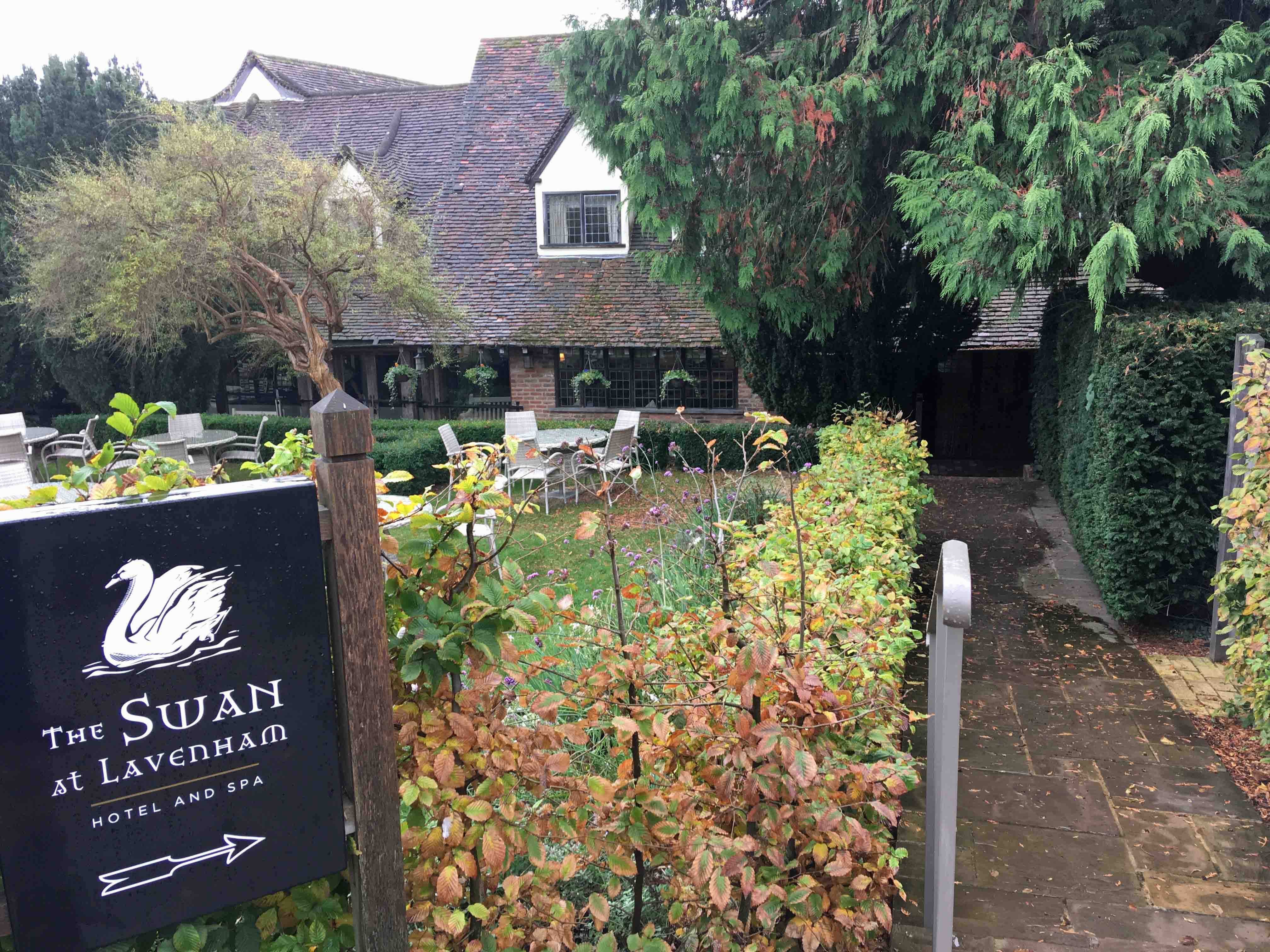
The Swan. Home of the atmospheric Airmen’s Bar, the Swan also has rooms and two eating possibilities.

IMG_0573 lr.jpg

The restaurant is excellent, offering modern British cuisine of nearly the same quality as The Great House although it does not have quite the same ambiance. Duchess proclaims her goat’s cheese pannacotta with beetroot granita as one of the most interesting dishes she has ever tasted.

IMG_0636 lr.jpg

The Swan’s Brasserie is more casual but with a bunch of tables and plastic chairs set up in a hallway, DonQui is not tempted.

IMG_0617 lr.jpg

Attached to the Swan is an excellent Spa with a full range of treatments and a hot tub.

IMG_0553 lr.jpg

Number 10 gets good reviews on TripAdvisor. The old timbered building and interesting menu posted outside tempts DonQui. When he goes inside to potentially make a reservation his ears are assaulted with the sounds of manufactured pop music of the worst kind. When he asks if this sort of stuff is played through dinner he is informed that it is. With a gentle snort he turns on his hooves and looks elsewhere.

IMG_0633 lr.jpg

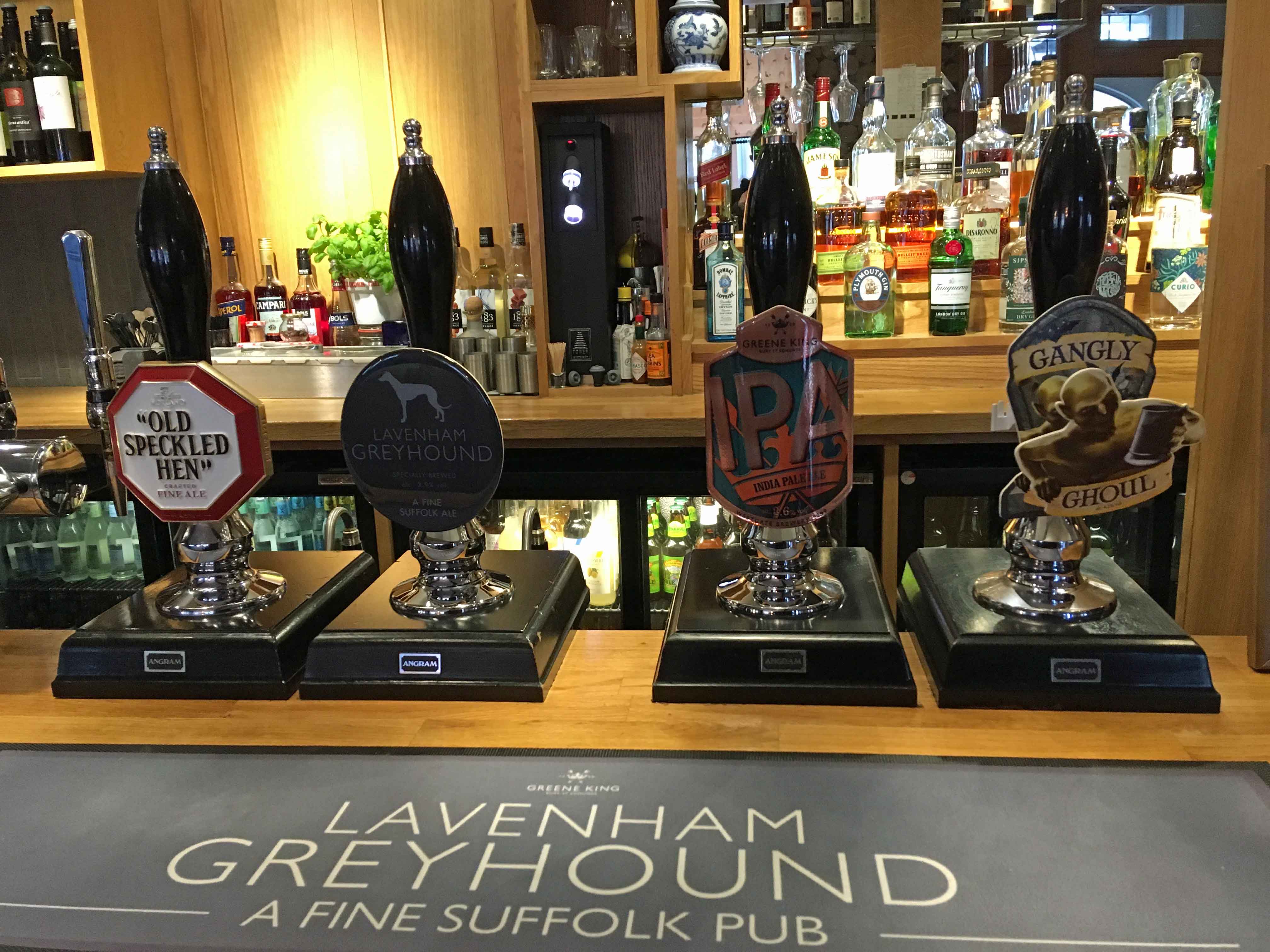
The Lavenham Greyhound is a Greene King pub. DonQui goes in for an afternoon drink and enjoys it. He cannot vouch for the food but the menu has fairly typical good pub food options. The bowls of soup he sees being brought to another table look good.

lavenhamtearoom 2.jpg

The Guildhall  has a very good café offering tea, coffee and baked goods. Their scones are baked on the premises and DonQui tucks into one along with clotted cream and a blackcurrant jam while Duchess takes hers with raspberry jam. The scones are truly excellent. It is well worth a stop.

A bit of France in Suffolk

In the heart of rural Suffolk lies Lavenham — England’s best preserved medieval town. In the heart of Lavenham is an unexpected little corner of France.

IMG_0536

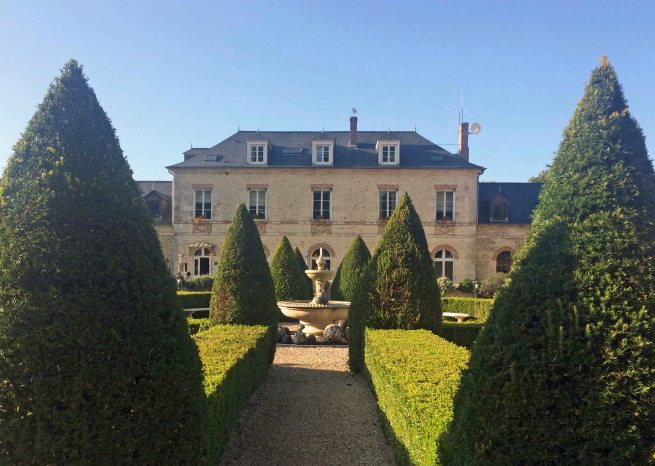
Over thirty years ago, the 14th century ‘Great House’ on Lavenham’s Market Place was bought by Régis and Martine Crépy. They converted it into a fabulous 5-room boutique hotel with a gourmet French restaurant.

DonQui is staying at The Great House for a couple of days while he explores Lavenham. It is as quintessentially French as the rest Lavenham is medieval English. The owners, staff, chef, and ambiance are all French. It seems to DonQui as if he has crossed the channel as soon as he steps over the threshold. For the francophile DonQui this is all very good news, especially the prospect of a French style dinner in owner-chef Régis Crépy’s award winning restaurant. He is not disappointed.

IMG_0550.jpg

He and Duchess opt for the 3 course set menu which at £36 is great value for top end cuisine from a renown chef who is often on the premises.

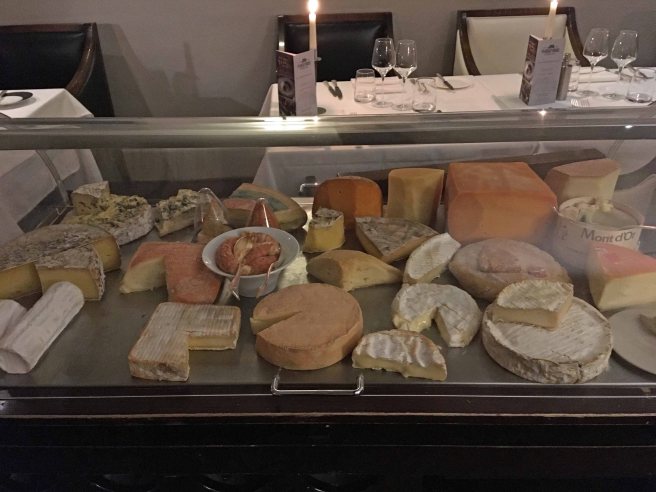
Spying the fantastic looking cheese board on the way in he decides to add a cheese course before desert which he and duchess will share. With 19 AOC cheeses it is reminiscent of the cheese board he sampled recently at Domaine de Barive.


IMG_0522

The food more than lives up to expectations. It is modern French cuisine using mostly local ingredients although the cheese is imported from France and the scallops come from the Isle of Man. The dishes are perfectly cooked, very well balanced, and not overly fussy. There are also a very good selection of wines by the glass. DonQui generally prefers this with a multi course meal as it allows him to sample different wines with different dishes.

IMG_0523

Highlights include the queen scallops with an avocado-lemon mousse and seaweed butter, which DonQui has as his starter. The accompanying mousse gives just the right amount of citrus taste to set off the delicate small scallops.

IMG_0527

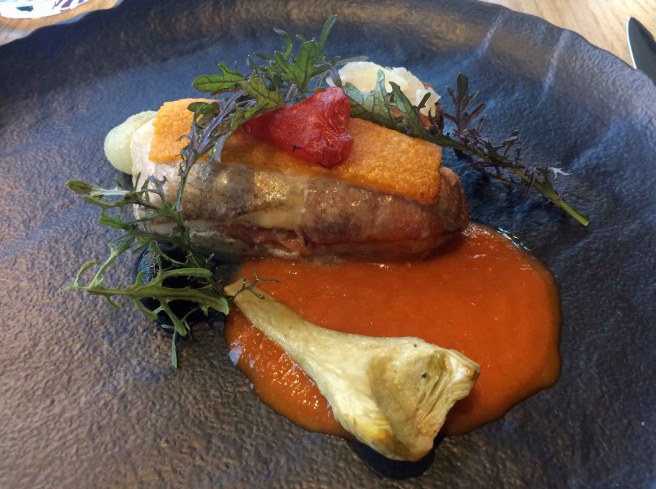
Duchess pronounces her main of skate wing with capers and tomatoes as ‘astounding.’ Skate is not a fish DonQui has been particularly keen on in the past. When he has a taste of this one he is most impressed. The fish takes the taste of the capers and tomatoes beautifully and DonQui decides he will try cooking skate wing himself at some time in the future.

IMG_0526

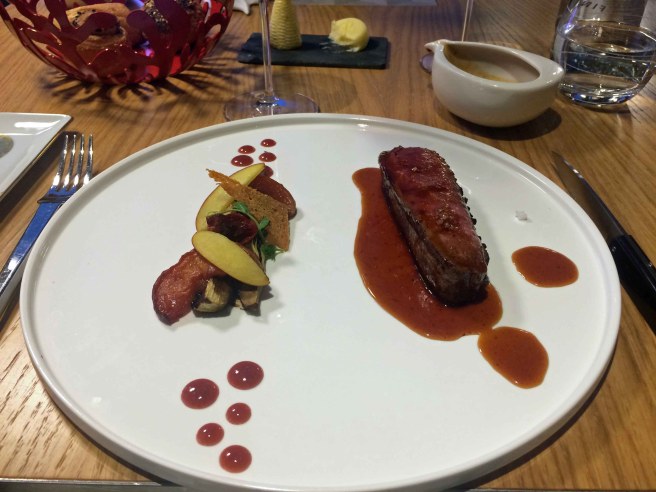
The meat dishes are just as good as the fish. DonQui’s only mild criticism is that the additional portions of vegetables and potato do not match the standard of the main dishes. They were also quite unnecessary.

IMG_0529The cheese selection is a delight, all perfectly ripe and served at room temperature. DonQui likes having cheese before a sweet to finish off his wine. Unfortunately in many English restaurants a cheese course is brought straight from the fridge and is therefore often tasteless.

IMG_0531

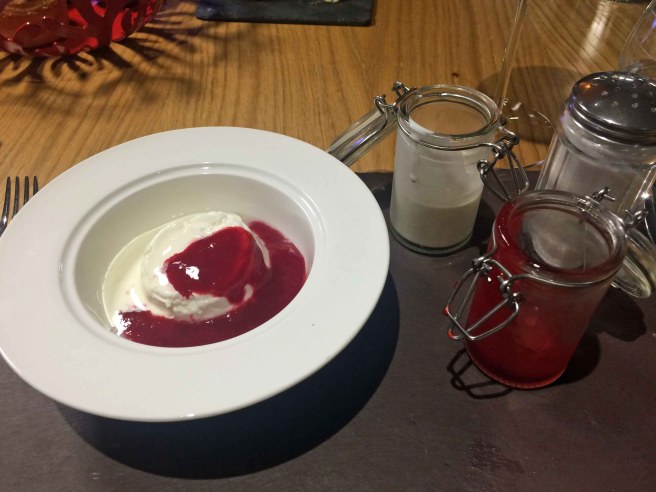
The deserts are just as good as the previous courses.

The hotel rooms are spacious and comfortable. The modern furnishings and conveniences tastefully fitting in to their ancient surroundings. One of the rooms has a Jacobean four poster bed which DonQui and Duchess decide to try out on a future visit.

IMG_0590.jpg

Breakfast is a typical French-style buffet. The smell of the croissants and bread being baked on-site are a perfect alarm clock for DonQui.

IMG_0591.jpg

Cooked options from poached eggs on toast to a ‘full English’ are also available.

DonQui thoroughly enjoyed his stay at The Great House. It is not inexpensive but given the very high quality it is value for money. He will definitely come again. Lavenham itself is also well worth a visit and DonQui will no doubt have more to say about the place before too long.

Rumour has it that Régis Crépy is looking to sell up in order to open a new restaurant in London with his son. If you want to experience this wonderful French oasis in the heart of Suffolk you may wish to go sooner rather than later.

Canadian Thanksgiving Feast

Back home from his travels DonQui decides to get cooking again.

Today being Canadian Thanksgiving, he decides to put together a Thanksgiving feast. Central to this has to be a turkey which is a little difficult to find in the UK at this time of year.

IMG_0448.jpg

Fortunately his friendly local butchers — Mills & Sons & Daughters are able to find him a lovely small bird. DonQui finds that smaller turkeys have much better taste and with this one at just over 4kg (9 lbs) he won’t be stuck with leftovers for weeks afterwards.

bb4e4e-20140811-wildrice01 2.jpg

Another essential for DonQui is wild rice which comes from the great lakes of Canada and the northern USA. Many packets of wild rice in the UK are sold mixed with white rice. This is a silly combination as wild rice requires much longer cooking than ordinary rice. If you want to mix the two they need to be cooked separately or otherwise you will end up with one still too hard or the other too soggy.

Traditional accompaniments would be sweet potato and squash or some other autumnal vegetables. DonQui’s guests had requested roast potatoes and peas. He is happy to oblige even if they are not the most authentic of Thanksgiving side dishes.

Cranberry sauce is another important addition to a turkey feast. This time he uses a store-bought jar although he has made it himself before. Cranberry sauce is quite easy to make and DonQui’s recipe can be found here.

DonQui decides he will stuff the turkey. As this entails quite a bit of work, it is not something DonQui does as a matter of course. Due to the time it takes he prefers to prepare the stuffing the day before, making it much easier on the day. He also pre-prepares the gravy base for the same reason.

Here are his recipes to serve 4-6 people depending on appetites and the desire for left-overs

Stuffing Ingredients
A handful of chopped turkey and/or chicken livers (about 6 whole livers)
Half an onion finely chopped
A good bunch of chopped parsley (about ½ a cup)
A good teaspoon each of fresh chopped sage, rosemary and thyme (reduce the amount if using dried herbs)
A bit of grated nutmeg
6 slices of stale white bread cut into squares leaving crusts on
a handful of chopped dried cranberries (optional)
a handful of chopped chestnuts (optional)
a splash of milk
salt and pepper to taste
butter for cooking (mix with a little vegetable oil if desired)

Stuffing method

IMG_0436.jpg

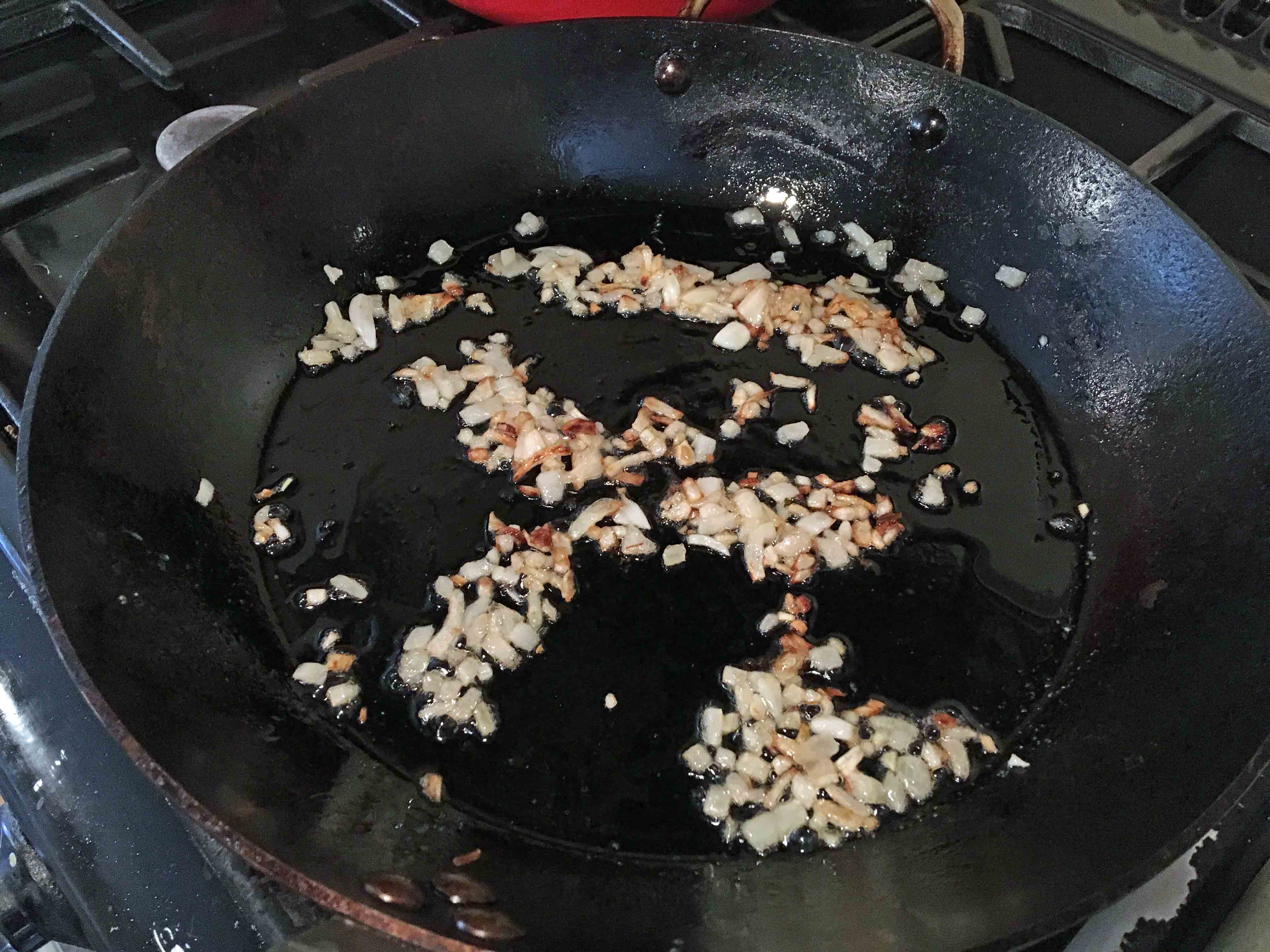
Gently pan fry the onion in butter until soft and it begins to colour

IMG_0440 2.jpg

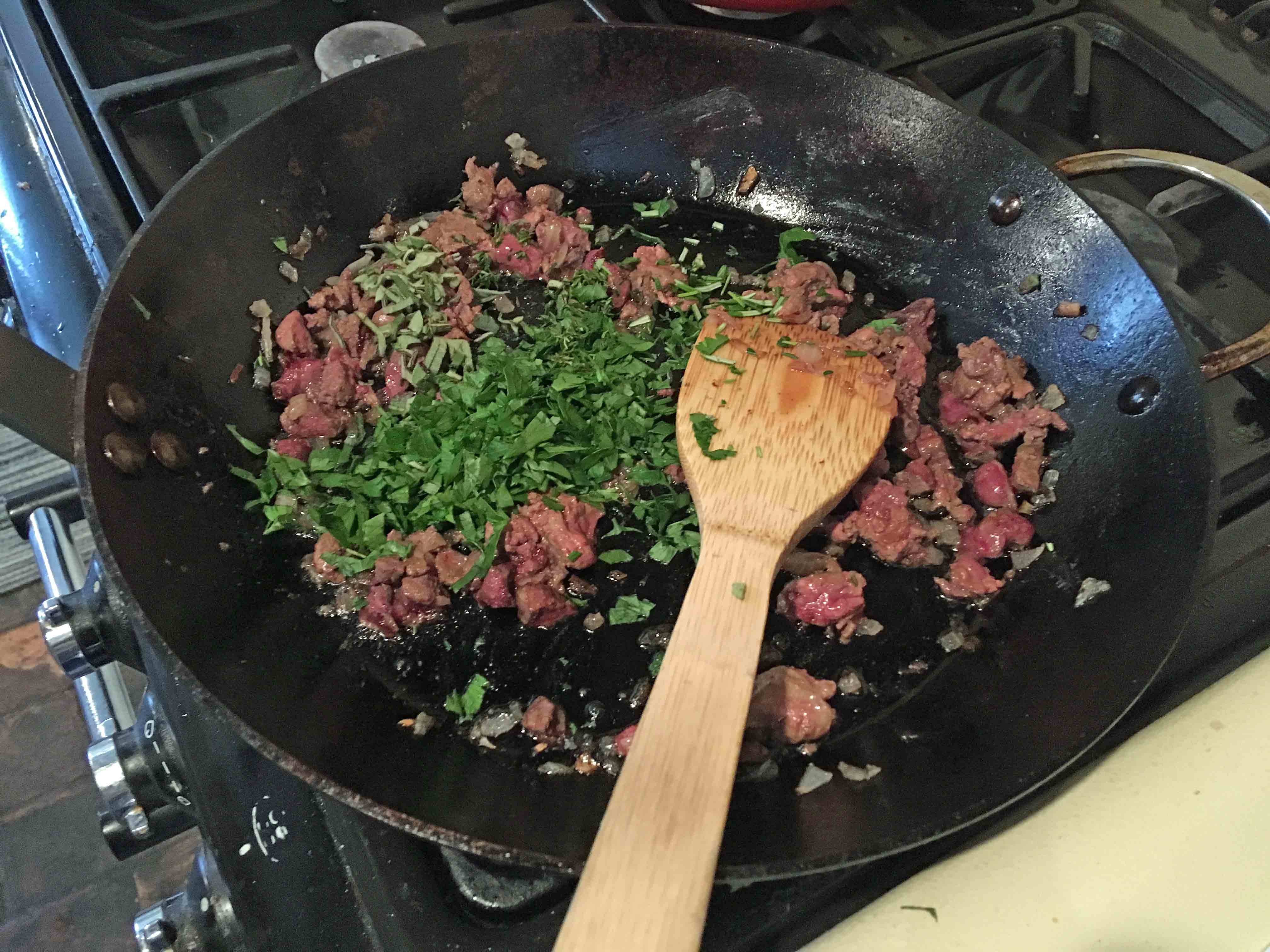
Add the chopped livers and stir fry over a low heat until most of the pinkness is almost gone. Add the herbs, nutmeg, salt and pepper and continue cooking over a low heat until well mixed.
Set aside to cool

bread.jpg

Put the cut bread into a bowl

IMG_0442 2.jpg

Moisten with a little milk and kneed it together with your hands until the volume is reduced and the bread becomes almost dough-like but not too soggy. Squeeze out any excess liquid.IMG_0444 2.jpg

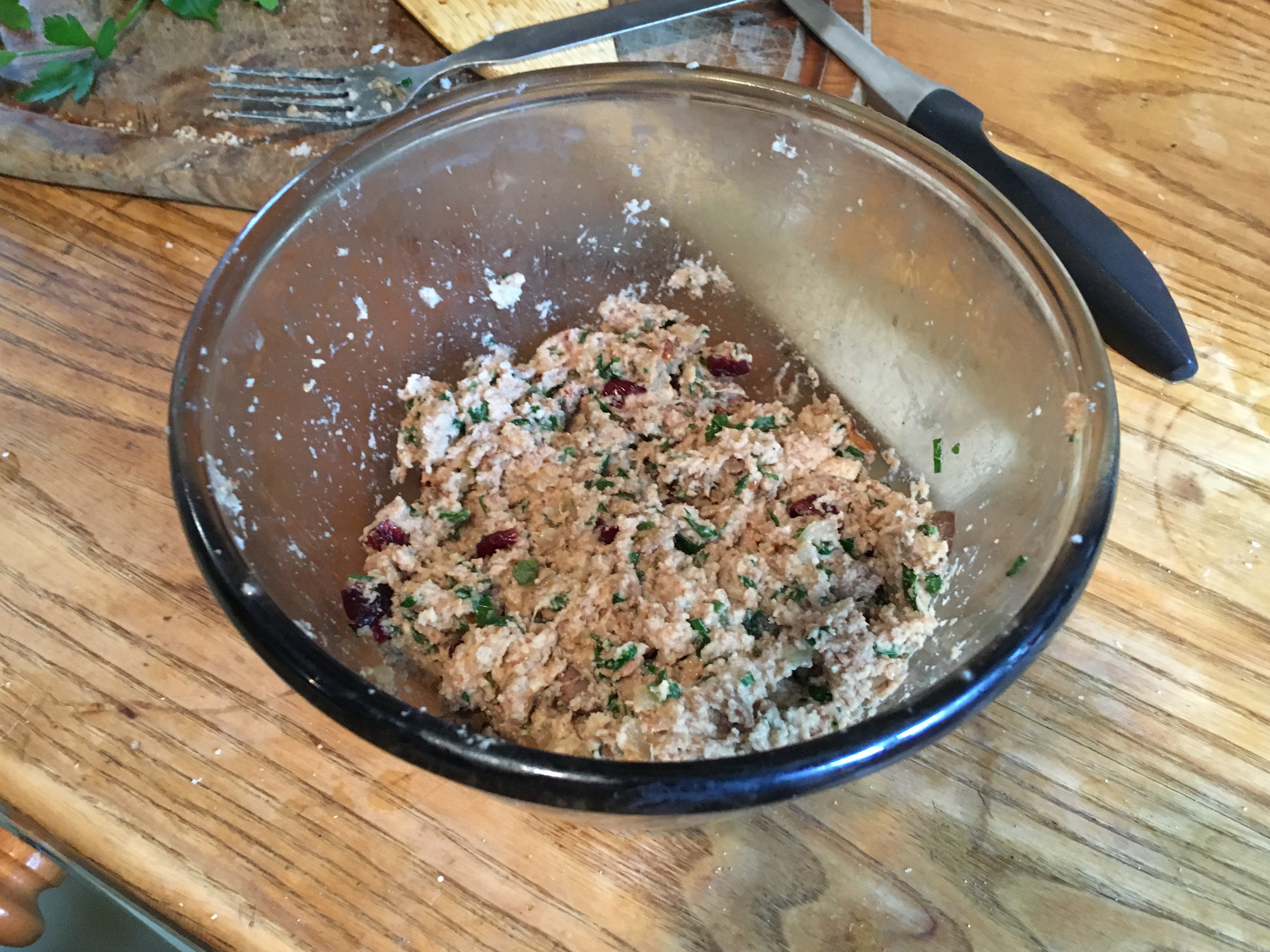
Mix in the liver/onion/herb mixture along with the cranberries and chestnuts if you are using them. This time DonQui uses only the cranberries. They add a delightful taste burst to the finished stuffing.  You can start this off with a fork but to get it really well mixed you will need to get in there with your hands.

IMG_0446.JPGWhen it is throughly mixed it should have the look and constituency of a course paté. Set aside for at least a couple of hours or overnight
Preparing the Gravy base.
Place the turkey giblets (neck, kidney and heart but not the liver) along with a roughly diced carrot and celery stalk in a roasting pan along with a quartered onion leaving the outer skin on. DonQui also likes to clip the wing tips off the turkey and add these also. The liver goes in to making the stuffing.

Sprinkle with a little salt and pepper and drizzle with olive oil. Place the roasting pan in a pre-heated oven at 160º and roast for about 1 hr until the vegetables have begun to brown but not burn.

IMG_0435.JPG

Deglaze the pan with a splash of dry white wine and transfer everything into a large pot. Add water to just about cover, along with a bay leaf and a few sprigs of rosemary and thyme. Simmer the mixture for at least an hour until all the flavours combine. For a deeper taste use chicken stock (or better yet turkey stock if you have it) in place of some or all of the water. This could be cooked up in the roasting pan but DonQui prefers to use a pot. Its narrower base makes it easier to cover the ingredients with liquid.

Strain and reserve the liquid until ready to make the gravy. Discard the solid ingredients. DonQui does this the night before to reduce the number of activities on the day of the feast.
The Wild Rice
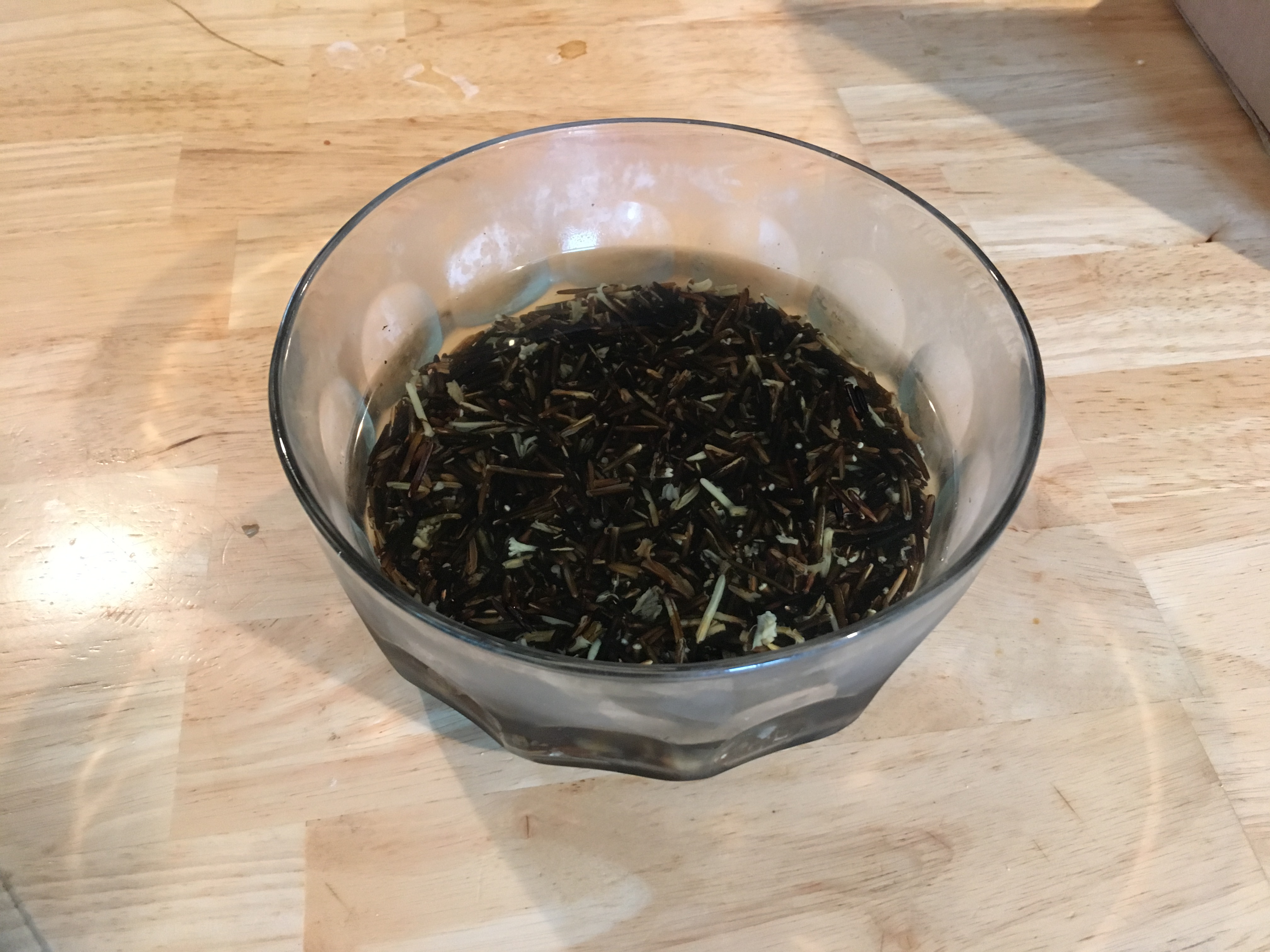
Properly cooked, wild rice expands to almost 4 times its dry state.

IMG_0450.JPG

Soak a cup of wild rice in 4 cups of water and leave overnight. The grains will burst at the ends, exposing the white insides.

About 1 hour before serving, drain the soaked rice and place in a pot with three times its volume of salted water. For an even better taste substitute about 1/3 of the the water with chicken stock.

Bring to the boil and simmer for 45 minutes or until tender.

The Turkey

Take the turkey out of the fridge at least 1 hour before cooking. Pre-heat the oven to 180ºC.

IMG_0451 2 copy.jpg

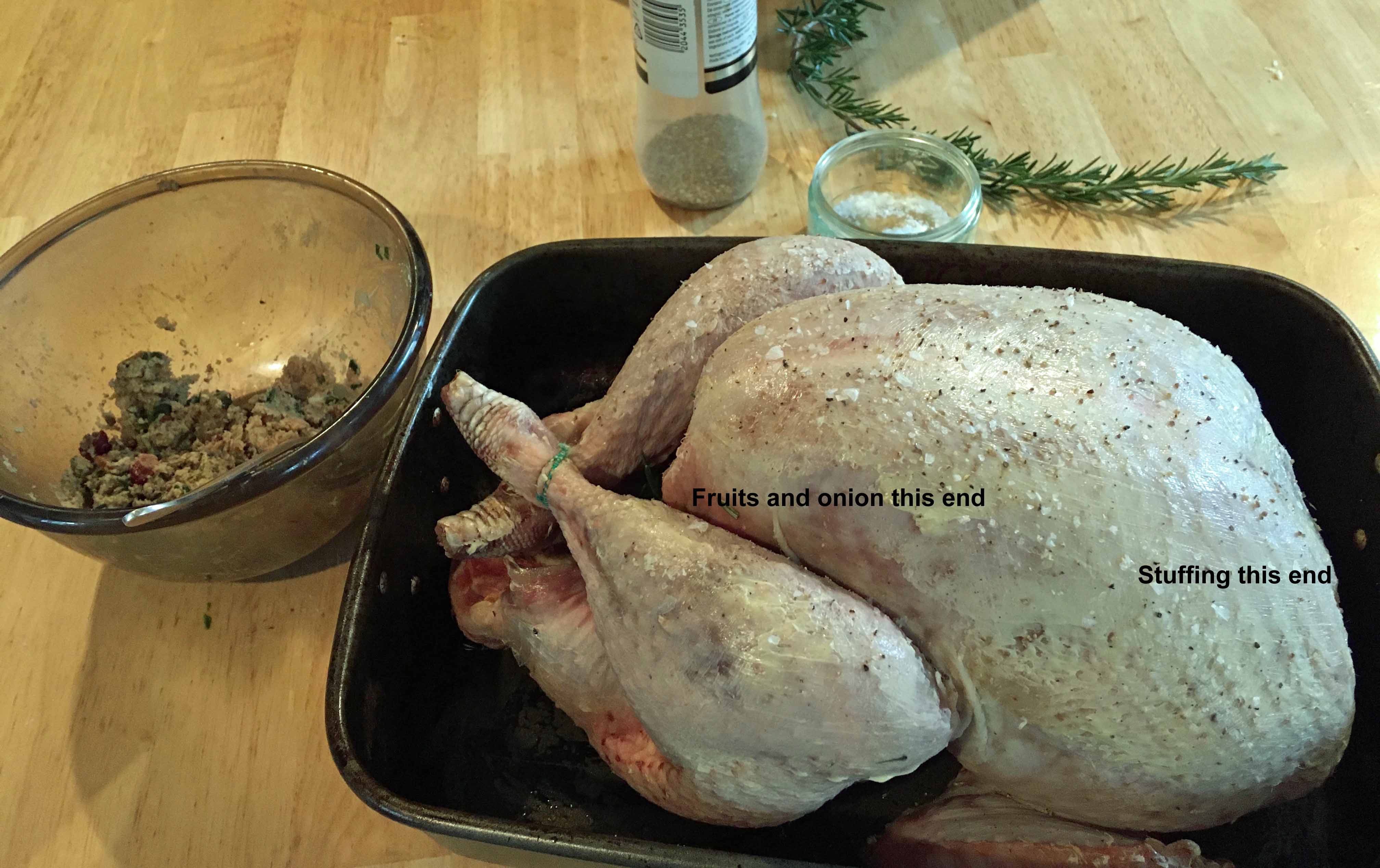
Stuff the neck end (back) of the turkey with the stuffing and close the skin back over it. DonQui tends to secure the neck flap with a wooden cocktail stick but this is not essential.

Place two halved citrus fruits (lemons or clementines) inside the main cavity of the turkey along with sprigs of fresh rosemary and/or thyme. DonQui also adds half an onion (optional). These will steam the inside of the turkey as it cooks and add greater flavour to the gravy.

Warm some butter in your hands then rub and massage it all over the bird. Then sprinkle with salt and black pepper.

Place the turkey in a roasting pan. Cover with tinfoil (aluminium foil). Place in the oven and roast at 180º C for 25-30 minutes per kilo. Remove the tinfoil for the last 40 minutes of cooking. This will give make the skin turn a nice crispy golden brown.

Take the bird out of the oven. Use large tongs, or tongs and a carving fork, to tip the bird up to let the juices from the cavity pour out into your pre-prepared gravy base. Then place it on a carving board, cover with tinfoil and a couple of tea towels (dishcloths) and let it rest for at least 30 minutes and up to 2 hours). During this time the bird will continue to cook.

If you are worried whether the turkey is properly cooked, pierce the thickest part of the thigh with a sharp knife or skewer. If the juices run clear then it is done. If you like to use a thermometer (DonQui never does) then the internal temperature should be 65ºC. Be careful of overcooking as the breast will dry out.

IMG_0456 3.jpg

While the bird is resting, get on with cooking the vegetables and finishing off your gravy.

Finishing the Gravy
After pouring the juices from the cavity of the turkey into the gravy base, bring it back up to the boil and let simmer.

Pour off all the fat and oil from the empty roasting pan, place onto the stove top at a moderate head and deglaze the pan with a good splash of white wine.

Scrap up all the brown bits with a wooden spatula and then strain the juices into the simmering gravy base.

Thicken the gravy either with a roux of flour and butter or cornstarch mixed with water. DonQui likes to use a roux and he describes his method of doing this in his recipe for rich meat sauce.

If you do not pre-prepare a gravy base then you should add chopped carrot and celery with a quartered onion to the roasting pan along with the turkey. After deglazing the pan as above add 500ml of chicken or turkey stock and add this to the juices from the cavity of the cooked turkey.

After resting, more juices will have accumulated on the platter or in the runnels of the carving board. Add these to the gravy before serving.

IMG_0458 2.JPG

DonQui was most pleased with the way his Thanksgiving feast turned out.

IMG_0460 2.jpg

The empty plates and dishes afterwards bore testament to the enjoyment of others. All are agreed that the early October Canadian date for Thanksgiving is much more sensible than the US November one. It is, of course, more suitable for northern climes but it also gives a nice separation from Christmas.

Burgers and Beer

There was a time, not that long ago, when finding good beer in the USA was just about impossible. Now, thanks to the craft beer revolution, DonQui is able to find a decent brew in the US almost as easily as he can in Europe.

IMG_0168.jpg

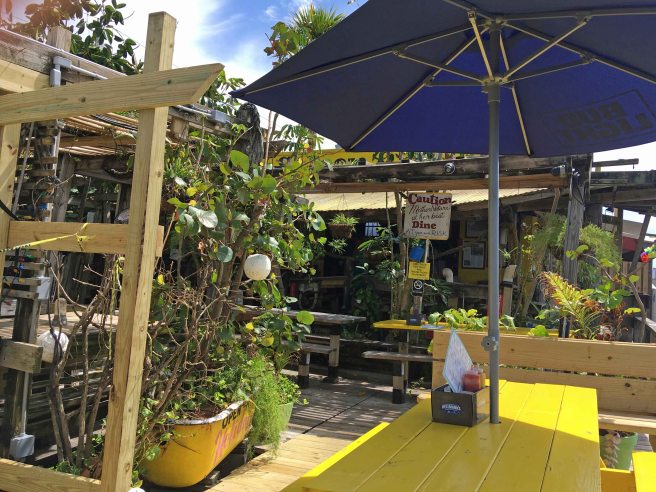
At the marvellously ramshackle Le Tub, in Hollywood, Florida, DonQui makes the acquaintance of a rather pleasant Yuengling Lager. Claiming to be from the oldest brewery in America it has a slight amber colour and more taste than your average lager. Apparently Mr Yuengling is a Trump supporter so although he enjoys the brew, DonQui will not make a habit of drinking it very often.


IMG_0166.jpg

With its eclectic furnishings…

IMG_0162.jpg

…and great view over the Intra-Coastal Waterway,  Le Tub seems the perfect place for a burger and beer.

Apparently Le Tub’s burgers were at some point voted by readers of GQ Magazine as the best in America, so DonQui decides to sample one. With 13 ounces of meat, the burger is not for the faint of heart but it is truly delicious.

IMG_0163.jpg

Although a bit out of the way to the south of Fort Lauderdale, DonQui is very glad to have been guided to Le Tub.

It is a perfect place to while away an afternoon in the Florida sun.

Crêpes Suzette

Before leaving his culinary tour of Domaine de Barive, DonQui wishes to mention one more outstanding experiences at their restaurant. This is their Crêpes Suzette.

IMG_2340 lr.jpg

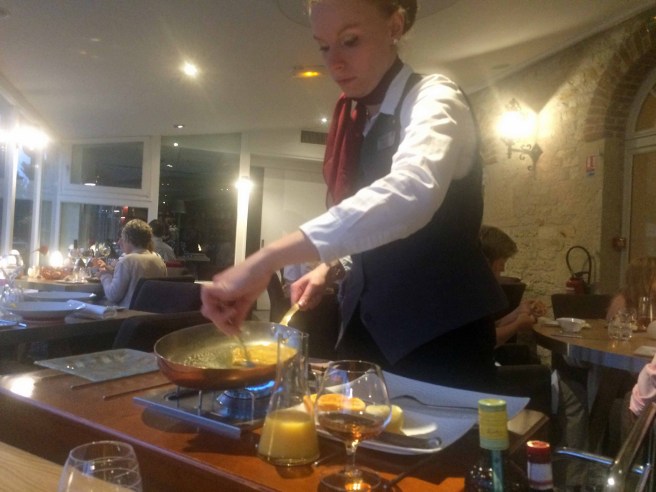
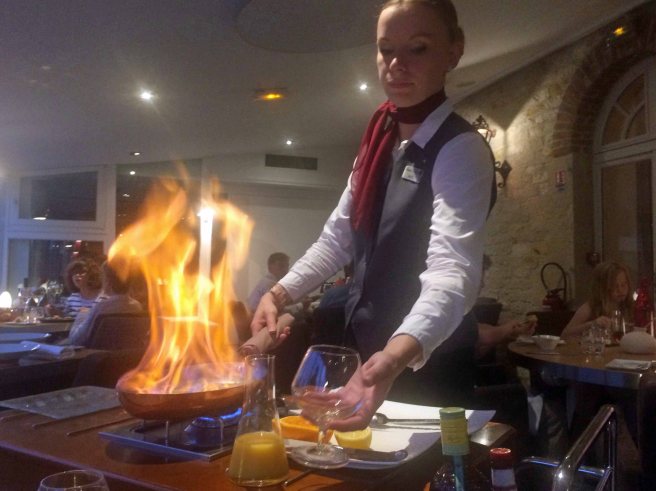
Crêpes Suzette may be a little bit old fashioned but then so is DonQui.  Although they are mostly renown for the flashy at-table presentation, the taste of pancakes with citrus, butter and Grand Marnier, is pretty hard to beat.

IMG_2345 lr.jpg

They are prepared at DonQui’s table by the skilled, experienced waitress who takes her time. She concentrates more on making sure the pancakes are perfectly prepared, rather than the accompanying theatre.

IMG_2348 lr.jpg

That is not to say that the preparation is without theatre at the time of flambéing.

IMG_2349 lr.jpg

On the plate the dish looks simple and it it. The taste, however, is sublime.

Cheese, Wine and Beer

No matter how good a meal has been, for DonQui, a good cheese course is often his favourite part of a long leisurely dinner.

Cheese and wine simply go together. It is for this reason he always takes cheese before desert, prolonging the savoury tastes and finishing off the wine at the same time.

IMG_2320 lr

DonQui’s previously mentioned the superb cheese board at Domain de Barive’s Restaurant des Epicuriens. Before leaving he wants to try it again and he asks the sommelier to choose a glass of wine for him to accompany his cheese.

The sommelier peers over the cheeses DonQui has selected, thinks for one moment, pauses for a second, then makes a most interesting suggestion.

IMG_2336 lr.jpg

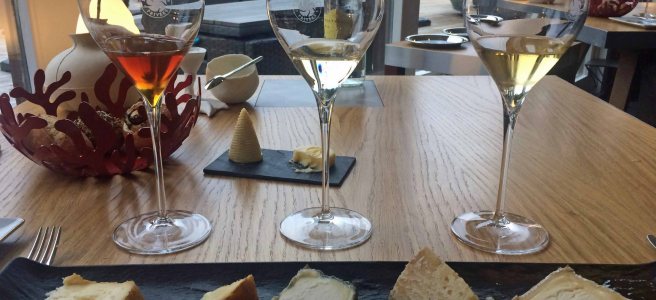
Given the wide variety of cheese flavours DonQui has selected, the sommelier says that no one wine would go perfectly with all. What DonQui needs is three different accompanying drinks. DonQui silently tots up his alcohol tolerance, bearing in mind he had a glass with a previous course and a beer before the meal.

The sommelier reassures DonQui, telling him that for the price of one glass he could have three small ones. This seems like something worth trying.

DonQui had anticipated the sommelier would appear with red wines with his cheeses, or perhaps two reds and one white. He could not have been more wrong.

IMG_2338 lr.jpg

To go with his local cheeses (on the left of the photo), he is brought a honey-coloured ‘biere du garde’ — a special ‘keeping’ brew from northern France which is reminiscent of some Belgian Trappist beers. There is champagne for the soft goats’ cheese (centre of photo) and a white wine from the Pyrenees to go with the Italian provolone and creamy Pyrenean white cheese (right of photo).
It all feels very indulgent but then DonQui likes to indulge himself. Left to his own devices he probably would have gone for a familiar hearty red wine for his cheese. He is glad that he did not. Not only were the sommelier’s choices absolutely perfect but they opened DonQui’s eyes to other new possibilities.
Great Food and Wine

IMG_2332.jpg

For his second meal at Domain de Barive’s Restaurant des Épicuriens DonQui has the time to experience the full set menu. It is utterly superb – each dish an absolute delight.

IMG_2278 lr.jpg

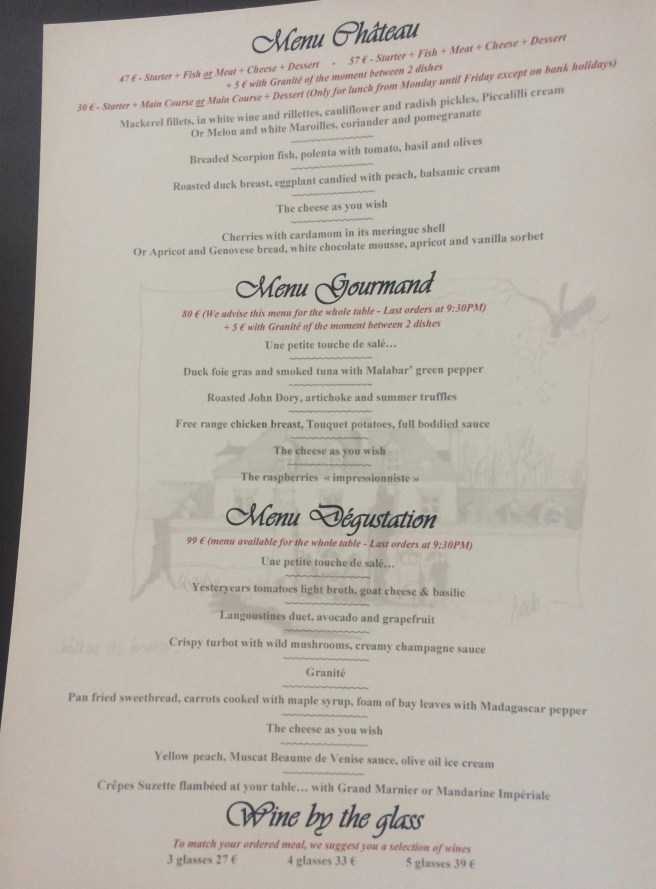
After as relaxing Leffe beer on the terrace, which comes with a selection of tasty nibbles, DonQui makes his way to the restaurant where he orders the Menu Château.

IMG_2334 lr.jpg

The meal is preceded with a ‘petite touch de salé…’ or ‘amuse-bouche’.

IMG_2305 lr.jpg

Along with this there are a selection of breads and two different locally produced butters.

IMG_2301 lr.jpg

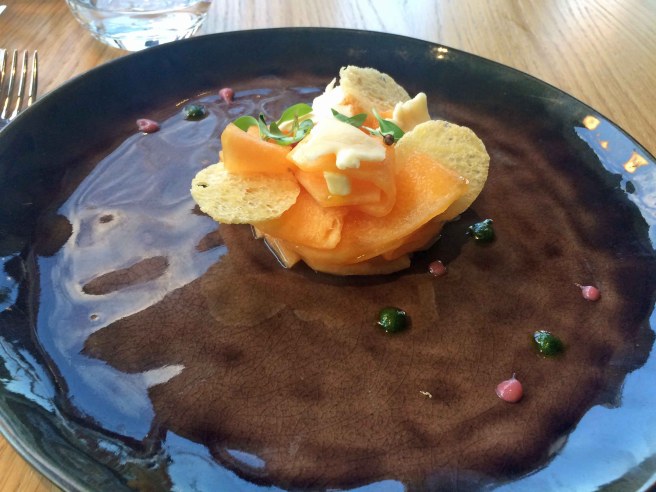
DonQui chooses the Melon with Maroilles (a local semi-soft white cheese) as his starter.

IMG_2303 lr.jpg

Then comes the Scorpion fish with polenta and a tomato-basil sauce.

IMG_2308 lr.jpg

Followed by the most exquisite duck breast.

IMG_2315 lr.jpg

Feeling that the expansive cheese board would be a bit too much, DonQui opts for the Faisselle (a soft fresh cheese). There are two options for this — savoury, with herbs and shallots, or sweet with fruit coulis. DonQui goes for the sweet option.

IMG_2319 lr.jpg

Finally comes an incredible apricot desert.

Each course is a  absolute delight. The amounts are just enough to savour the tastes but not so much as to feel too full afterwards. Apart from the bread there are few carbohydrates. This allows DonQui to fully enjoy every course and not feel bloated afterwards.

IMG_2306 lr.jpg

Des Épicuriens offers a wide selection of wines by the glass. DonQui leaves the choices up to the young sommelier who suggests a different wine to suit each of the courses DonQui has ordered. His choices are excellent and DonQui is very glad that he went along with the sommelier’s suggestions. Despite a reasonable acquaintance with French wines, many of those on offer are quite unknown to DonQui. This allows him to sample wines that otherwise he may never have tried. The pairings with each course are perfect.

Personally DonQui is better than some which can show off a Michelin star or two. Too often he finds the food at many starred places a bit too fussy as the chef shows off his clever tricks. Here one gets an excellent modern take on great classic French food, alongside very knowledgeable and friendly service, in an atmospheric setting.

A Fine Domain in France

Needing to spend some time deep in the countryside of northern France, DonQui looks around for a good place to stay.

IMG_2277 lr.jpg

Not far from the medieval city of Laon, he stumbles upon the Domaine de Barive. It is a great find.

IMG_2352 lr.jpg

Set in in its own grounds amongst farmland, miles from anywhere it is approached by a long lane lined with poplars. With spa, outdoor terraces and a highly rated restaurant it looks like just the sort of place DonQui can enjoy a few days of tranquil contemplation along with a good meal or two.

IMG_2264 lr.jpg

His room is comfortable and spacious. The bathtub even comes with its own rubber ducks, for those who go for that sort of thing.

IMG_2324 lr.jpg

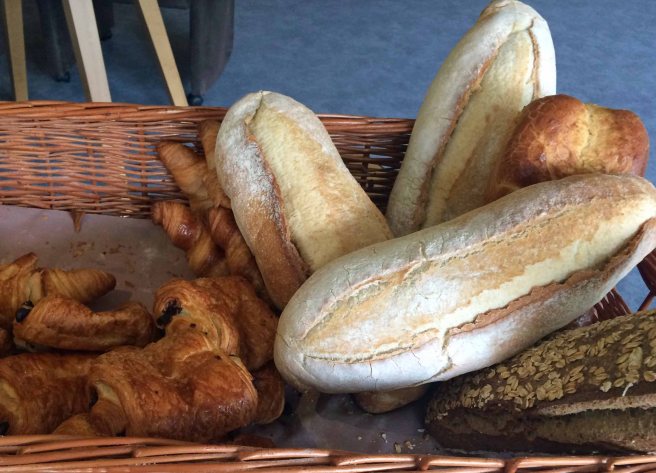
Breakfast is a typical French offering, made special by the fine selection of fresh, locally baked breads and pastries along with homemade jams. There is even champagne available along with juices, coffee and other hot drinks.

IMG_2312 lr.jpg

Best of all is the Restaurant des Epicuriens. DonQui arrives late after a horribly long wait for his rental car from the very inefficient Avis counter at Paris Charles de Gaulle airport.

IMG_2261 lr.jpg

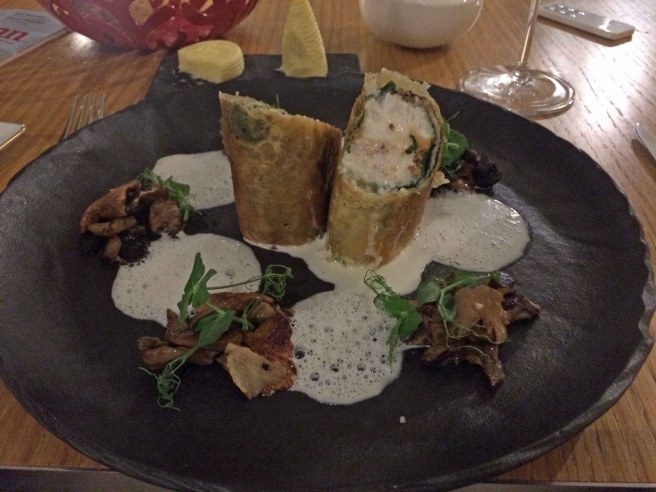
As in most French restaurants, the set menus offer very good value for money but at 9pm DonQui does not feel like a full 4-5 course meal so he orders a la carte, choosing the ‘turbot en trançon’ (turbot filets with spinach in a crispy phyllo pastry) with kumquats and mushrooms in a champagne cream sauce.  It is utterly delicious.

IMG_2320 lr.jpg

To finish off he opts for a selection of cheeses from the very tempting cheese board. The choices are so overwhelming that DonQui leaves it up to the very pleasant waitress to help him with his selections.

IMG_2262 lr.jpg

Very knowledgeable and helpful, she suggests a sampling of 5 different cheeses, all of which are perfectly ripe, providing a wide range of different flavours.

In Search of the Perfect Pizza

Pizza is a serious matter in Naples — the city in which it was invented and perfected. In DonQui’s humble opinion, pizza in Naples if far better that pizza more or less anywhere else on the planet.

IMG_0460

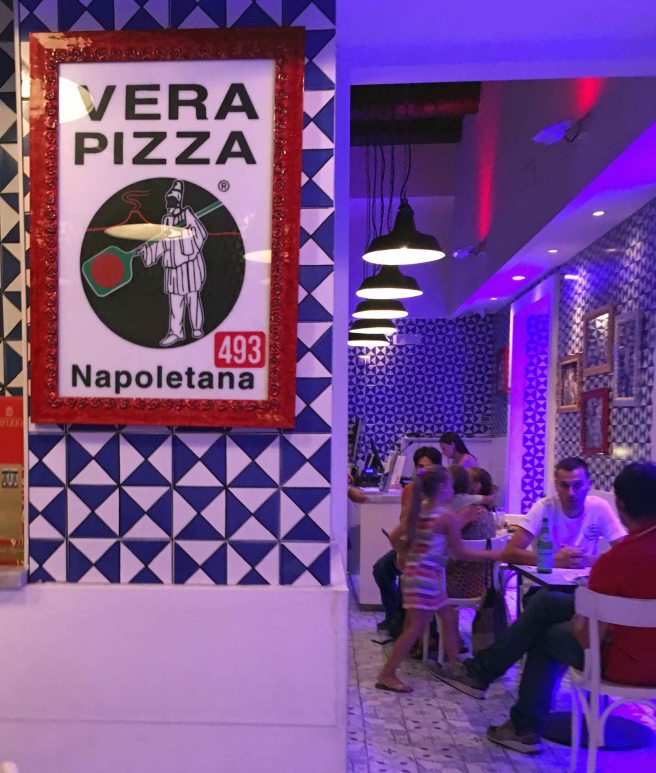
Standards are maintained by the Associazione Verace Pizza Napoletana (True Neopolitan Pizza Association), or Vera Pizza for short. It aims to promote and protect ‘true Neapolitan pizza’ in Italy and around the world.

IMG_0459

DonQui has a few tricks to ensure that his pizza lives up to expectations. Firstly he looks for a place that uses a traditional wood fired oven. Secondly he only ever orders pizza in Italy at night. Good pizzerias will fire up their ovens in the evening and it will take until close to 9pm before the ovens are properly hot enough to cook the prefect pizza. Thirdly he goes for simple classic ingredients, no bits of pineapple, pulled pork, curried chicken or other Anglo-Saxon atrocities for DonQui.

20170722-155125-largejpg

The classic Neapolitan pizza is the Margarita which is said to have been invented in Naples in 1889 for Queen Margarita in the early years of Italian unification. In a clever move of political sycophancy, its creator managed to replicate the colours of the new Italian flag: red (tomato), white (mozzarella) and green (basil).

IMG_1658

Anchovies, capers and black olives are other traditional ingredients which DonQui quite likes. Here the local anchovies are not as salty or overpowering as tinned anchovies can be outside Southern Italy.

Finally DonQui looks for a place that is not too fancy-looking while still pulling in a substantial local crowd. The many places lining the Via Partenope close to his hotel look inviting but DonQui worries that they might be overpriced tourist traps. A quick skim through TripAdvisor seems to confirm his fears with comments about dodgy surcharges and surly waiters abounding.

IMG_0448

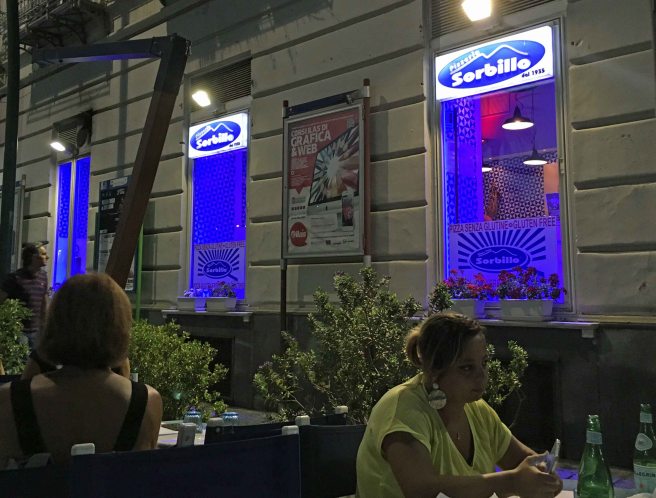
At the very end of Via Partenope, at the corner of Piazza Vittoria, sits an establishment with promise. It is just before 9pm and Sorbillo Lievito Madre al Mare is filling up with locals. Offering pizzas with top organic ingredients cooked in a wood fired oven it is little wonder that it is a popular place. There are even gluten free options, not that DonQui cares about such things.

IMG_0461

DonQui manages to get one of the last available tables as a queue forms behind him. Those arriving later put their names down on the waiting list and look on enviously as DonQui tucks in.

IMG_0458

By 21:30 a fairly large crowd has built up, all waiting patiently for their turn for a table.

The choices are interesting. Although the menu is in Italian only, DonQui is able to decipher enough to understand the basics. He had thought he might order a simple classic margarita but the Cetara catches his eye.

IMG_0450

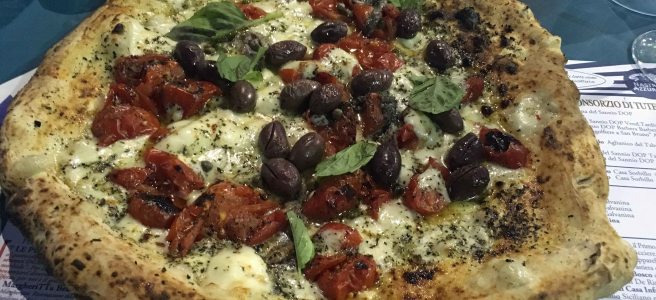
With fresh tomatoes grown on the slopes of Mount Vesuvius, smoked Provola cheese, capers, olives, oregano and Alici di Cetara, it sounds most intriguing. Alici di Cetara is an oil infused with anchovies. Reminiscent of garum, the infamous fish sauce which the Ancient Romans added to just about everything, DonQui decides he wants to try it.

IMG_0456

To say that it is delicious would be an understatement. The thin, springy crust, slightly charred from the super hot wood-fired oven is an absolute delight. The combination of cheese, tomatoes, basil, olives, capers and anchovies are a perfect taste of Naples. The pizza is large enough for him to share with Duchess and the bill is most reasonable — far less than any of his other previous Neapolitan meals.

DonQui is unaware that Gino Sorbillo is one of the most famous pizza chefs in the world. His coastal establishment is the second of his Naples outlets and he is soon to open one in New York’s Times Square. DonQui feels quite pleased with himself that he managed to discover Sorbillo’s seafront establishment before knowing any of this.